Excel spreadsheets, email inboxes, local folders: Many companies use these tools to manage their contracts. While this approach may work in the early stages, it quickly leads to a loss of control as the volume of contracts grows. deadlines is forgotten, documents can’t be found, and cross-departmental collaboration is virtually impossible. Cloud-based contract management solves exactly these problems—without the need for complex IT implementation. In this article, you’ll learn how cloud-based contract management software works, what advantages it offers over on-premises solutions, and what you should look for when selecting a SaaS solution.
What is a cloud-based contract management
In many companies, the number of contracts is steadily increasing. With every supplier, every service, and every customer project, new documents, obligations, and contract terms are added. What initially seems manageable with Excel spreadsheets, email inboxes, and folder structures quickly becomes confusing. Contract terms are forgotten, deadlines deadlines are missed, and important contract documents are scattered across various systems.
This is exactly where cloud-based contract management comes in. Instead of managing contracts manually, all documents are consolidated and organized in a structured manner within a single digital environment. This allows companies to maintain a clear overview of their current obligations, costs, and deadlines at all times—regardless of location or device.
contract management —a cloud-based software solution—is an efficient SaaS platform that offers automated processes and optimized workflows. Intelligent search functions centrally consolidate all contract data and make it accessible at any time. As a result, contract management transforms contract management from a time-consuming administrative task into a strategic success factor that combines efficiency, traceability, and legal certainty.
Benefits of Cloud-Based " contract management" Software
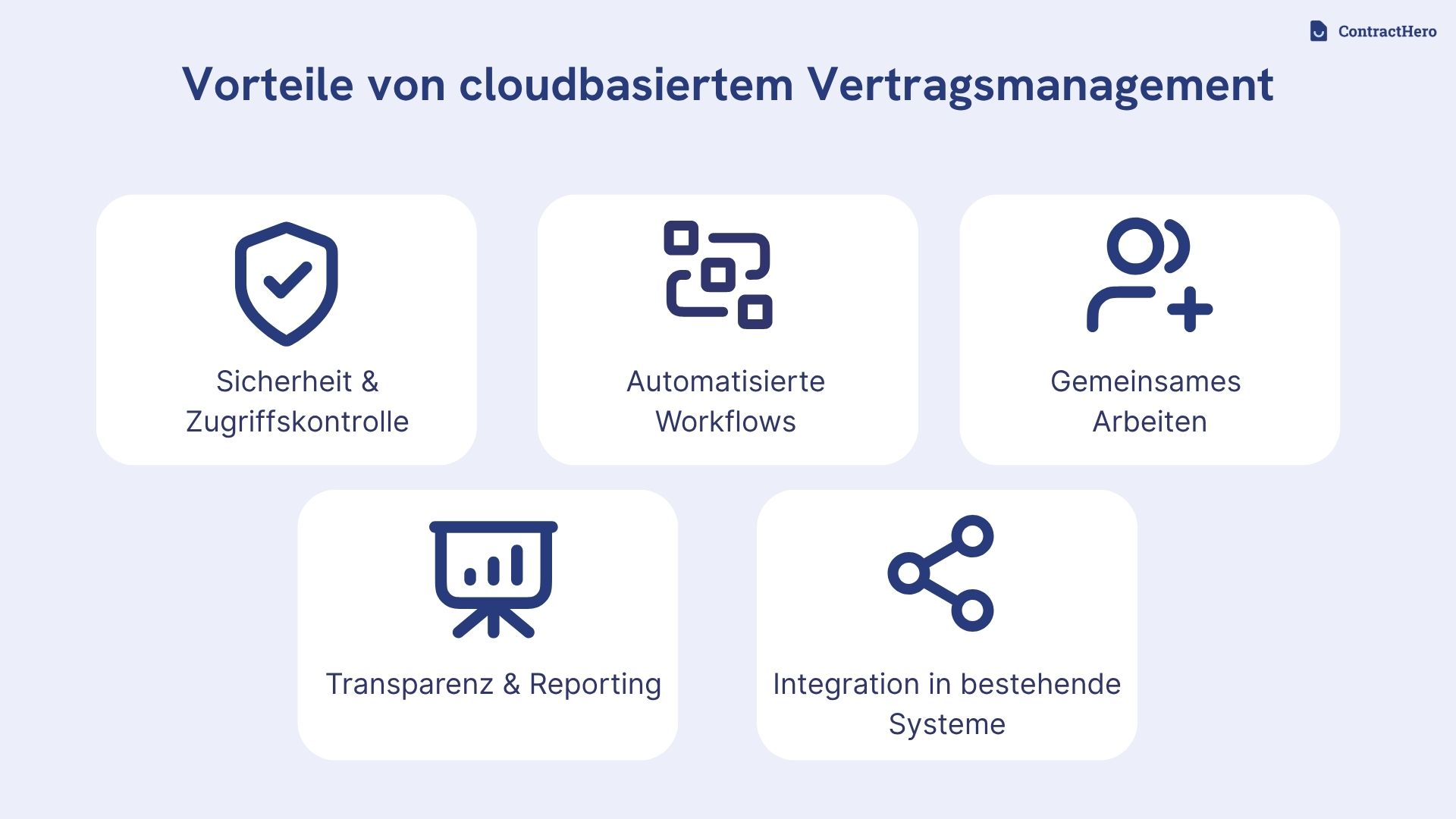
Cloud-based contract management software can do much more than just store contracts digitally. It ensures smooth processes, clear responsibilities, and consistent handling of all contracts throughout the entire company. Key benefits include:
- Centralized data management: All contracts and relevant information are bundled centrally in a cloud environment. This means that all data is in one place, enabling fast, structured and secure access.
- Automated Processes: Defined workflows automatically manage approvals, deadlines , and reminders. Since the software automatically handles recurring tasks, the risk of human error is reduced. This significantly reduces the occurrence of incomplete information, incorrect deadlines , or duplicate entries.
- Seamless collaboration: Several departments can access the same contract data, track changes and check documents at the same time.
- Transparency and Financial Overview: The structured overview provided by “ contract management ” software increases transparency regarding the nature and scope of all contracts entered into. This allows for better assessment and targeted management of financial risks and opportunities.
- Simple integration: interfaces to systems such as SAP, Salesforce, HubSpot or DATEV connect contract data with existing company processes. Information flows automatically between the systems, duplication of work is avoided and teams can work efficiently on a shared database
These factors transform contract management from an administrative task into a strategic tool that can reduce costs, save time, and improve contract management across the entire company.
How contract management works in the cloud
The way a contract management software cloud works can best be compared to a digital filing cabinet: All contracts are stored centrally in a contract management cloud, intelligently organized and managed automatically. This means they can be accessed at any time and from anywhere. The process starts with the digital capture and structured storage of contracts in the cloud. With the help of artificial intelligence (AI), relevant data such as terms, deadlines or contract partners are automatically recognized, indexed and assigned. Automated workflows then take over central tasks - such as forwarding contracts to the responsible persons, reminding them of upcoming deadlines or providing digital approval processes.
Integrated e-signatures enable contracts to be signed in a legally compliant manner directly within the system, while role- and permission-based models provide targeted access control. Through dashboards or filter functions, companies can maintain an overview of active, expiring, or completed contracts at all times. Upon completion, all documents are archived audit-proof . In this way, cloud-based contract management software provides a traceable view of the entire contract lifecycle, from creation to archiving.
How secure is contract data in the cloud?
To ensure that even confidential contracts are suitable for a contract management cloud, clear security mechanisms are required. Strong access control—such as two-factor authentication—is essential. This ensures that only authorized individuals have access to the documents. In addition, electronic audit trails ensure that every change or approval remains fully traceable.
As personal and confidential information is processed in many contracts, cloud solutions must be GDPR-compliant. This means that data may only be processed, stored and accessed in accordance with clear specifications. Providers should also comply with other European security standards such as ISO 27001 or TISAX.
Another key element is encryption. Modern encryption technologies ensure that contract data remains protected during transmission and storage. By choosing a certified provider with a clear security strategy for the contract management , you ensure technical security and adherence to relevant compliance requirements. This makes the cloud-based contract management software a reliable solution even for sensitive contract data.
Practical Applications of Cloud-Based " contract management" Software
Depending on the department or industry, the requirements for contract processes vary—from legal documentation to budget planning to supplier management. A cloud-based “ contract management ” software solution can be flexibly adapted to these needs and ensures structured, transparent, and legally compliant processes in every area.
The following examples show how different business units can benefit from an contract management cloud:
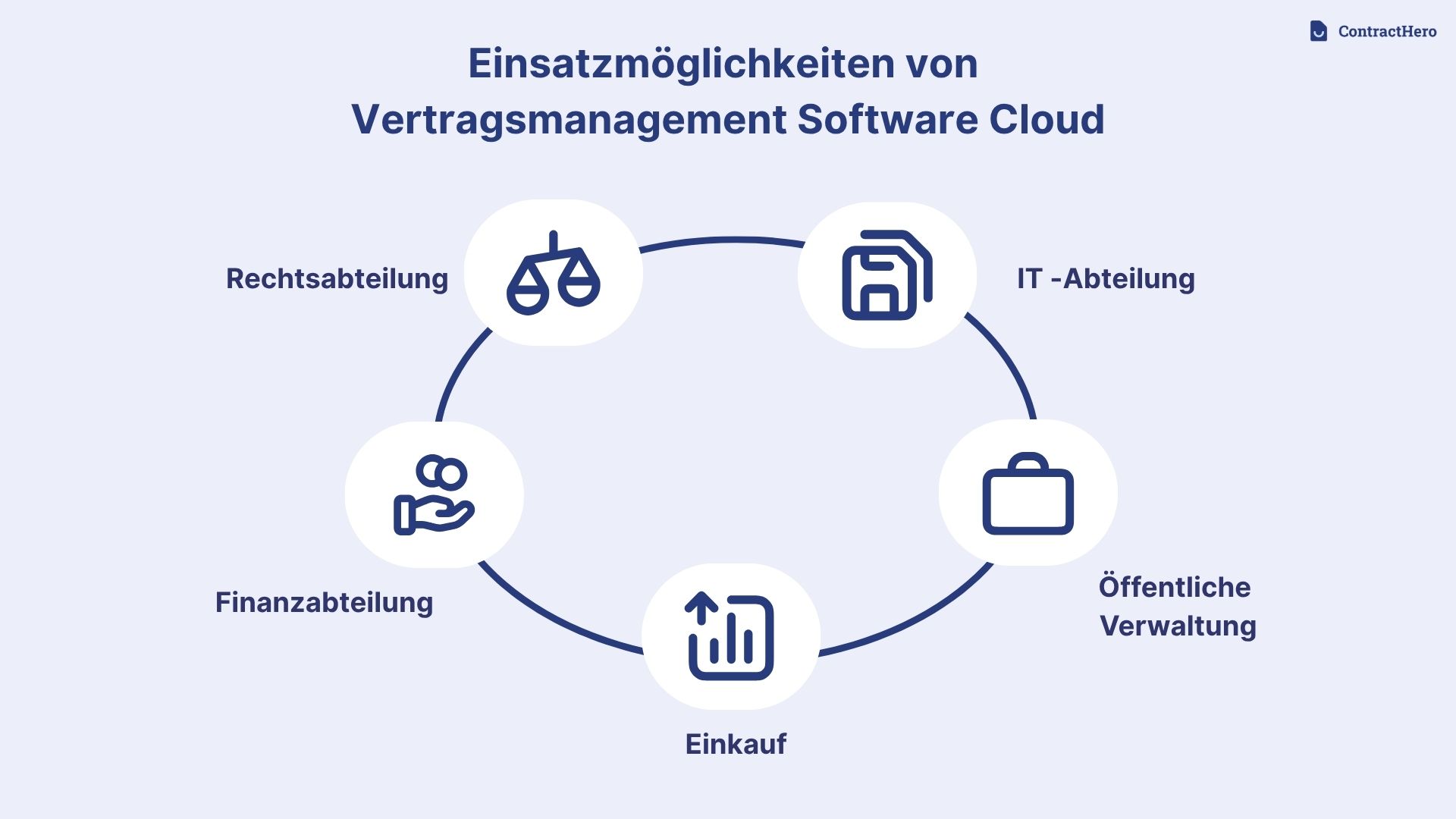
Legal department
contract management plays a central role in the legal department, where compliance with legal requirements and the minimization of liability risks are top priorities. Cloud-based contract management software makes it possible to systematically record, version, and archive all contracts at audit-proof . This allows legal professionals to maintain a clear overview of deadlines, contract terms, and legal obligations at all times.
Automated reminders and approval processes are particularly helpful, ensuring that contracts are fully checked and approved before they are signed. Clauses or contract types can be found quickly using intelligent search functions, which significantly speeds up processing and risk analysis. Every change is automatically logged, creating a complete audit trail.
Finance department
For the finance department, transparency regarding payment deadlines, financial obligations, and budget planning is crucial. Contract management software ( contract management) for the finance department provides a clear overview of all active contracts, as well as their costs and terms. Automated reminders ensure that payment and cancellation deadlines are reliably met, thereby reducing financial risks.
In addition, integration with accounting or ERP systems enables contract data to be directly reconciled with financial metrics. This allows controllers and CFOs to generate reports in real time, plan budgets with precision, and identify potential savings. Cloud-based contract management thus ensures well-informed decisions, seamless processes, and better control over all financial obligations.
Procurement
In purchasing, “ contract management ” software helps efficiently manage supplier relationships and framework agreements. All relevant documents—from quotes and purchase orders to contract terms—are centrally managed in the “ contract management ” cloud. This makes it easy to track contract terms, price changes, and minimum purchase quantities at any time.
Automated reminders prevent deadlines from slipping by unnoticed, while built-in analytics help compare terms and achieve better negotiation outcomes. Thanks to the cloud-based structure, procurement teams can collaborate across locations, thereby standardizing processes. The result: greater transparency, lower costs, and a stable supplier base.
Public administration
In public administration, numerous individuals and departments are involved in contracting processes—such as tenders, grant programs, or service contracts. Without a centralized digital solution, this quickly leads to confusing workflows, scattered documents, and lengthy coordination loops. A specialized cloud-based “ contract management ” software solution for public administration provides a remedy: All relevant documents are stored centrally and securely in the cloud, where authorized employees can access them simultaneously. Automated workflows accelerate approval processes, while every change is documented in accordance with “ audit-proof ” and the GDPR. The result is streamlined processes, clear decision-making paths, and secure management of sensitive information.
IT department
For IT teams, visibility and security are crucial. IT contract management software simplifies the management of license agreements, service-level agreements (SLAs), and maintenance contracts. All IT-related documents are stored centrally in the cloud, which allows for clear regulation of access rights and consistent compliance with security standards.
Automatic reminders allow IT managers to keep an eye on important terms or renewal clauses. At the same time, integration with tools such as Jira, Slack or Microsoft 365 enables a seamless connection to existing IT systems. This allows the IT department to remain agile, reduce risks and create transparency across the entire software and service portfolio.
How does implementation into existing IT systems work?
A modern cloud-based “ contract management ” software solution only realizes its full potential when it can be seamlessly integrated into existing enterprise systems. Through standardized interfaces and Application Programming Interfaces (APIs), information can be automatically transferred and processes linked together. This creates a smooth flow of information between systems such as accounting, CRM, or HR software, without manual intermediate steps or data loss.
Integration with SAP
SAP is one of the world’s leading enterprise resource planning (ERP) systems and plays a central role in financial, procurement, and controlling processes at many companies. Contract management software ( contract management) integrated with SAP creates a direct link between contract data and operational business processes. This allows supplier contracts, payment terms, and invoices to be automatically reconciled with the corresponding journal entries in SAP.
Synchronization ensures that contract values, terms, and deadlines are updated in real time and displayed in the corresponding modules. As a result, staff in Purchasing, Finance, or Controlling always work with consistent and up-to-date data. This reduces manual data entry and minimizes sources of error.
The integration of contract management software with SAP also enables precise budget control and improved transparency regarding financial obligations, which is a key advantage for efficient and secure corporate management.
Integration with Sharepoint
Microsoft SharePoint is a widely used collaboration and document platform that many companies rely on as a central repository for files. By integrating with cloud-based contract management software, contract documents can be managed, shared, and versioned directly within the familiar Microsoft environment.
All documents, comments and approvals are automatically synchronized between the two systems so that the latest version is always available. Employees can check, comment on or approve contracts without leaving their familiar work interface.
Integrating the " contract management" software with SharePoint thus significantly simplifies cross-team collaboration—especially for legal, finance, and procurement departments.
Integration with Salesforce
Salesforce is one of the leading customer relationship management (CRM) systems and serves as the central hub for sales, marketing, and service processes. Integration with a cloud-based contract management ( contract management) software solution makes it possible to map the entire contract process directly within Salesforce—from creating a proposal through negotiation to the final signing.
Contract data such as customer names, terms, amounts, and payment terms are automatically imported from the CRM. At the same time, teams can track in real time the current status of a contract, the applicable deadlines , and the next steps to be taken.
This makes the entire sales process more efficient and transparent. Contracts are always based on up-to-date customer data, which enables sales teams to prepare for negotiations in a more targeted manner, make informed decisions, and tailor offers more precisely to customer needs. This not only increases the chances of success but also improves the closing rate in the long term. This creates a seamless connection between sales and contract management.
Integration with Hubspot
HubSpot is a powerful CRM and marketing automation system that helps sales, marketing, and service teams manage customer relationships. Through integration with contract management software, processes are seamlessly connected: Contracts can be created directly from existing deals in HubSpot—including all relevant customer data, prices, and contract terms.
This eliminates the need for manual data entry, and everyone involved always works with up-to-date information. Progress in the contract process can be tracked directly in the HubSpot dashboard, while automated notifications alert users to upcoming deadlines or missing signatures.
This tight integration between contract management software and HubSpot ensures seamless workflows and a comprehensive overview of the entire sales cycle, from the first lead to the signed contract. Companies save time, avoid errors, and noticeably speed up their sales cycles.
Integration with Slack
Slack is one of the leading platforms for corporate communication and collaboration. Integration with a cloud-based contract management software ( contract management) ensures that updates regarding new, amended, or approved contracts are displayed directly in Slack channels.
Teams receive real-time notifications as soon as new contracts are created, approved, or finalized. Reminders regarding upcoming deadlines, terminations, or approvals are also sent automatically, allowing those responsible to respond in a timely manner—without having to open the contract management system.
This integration of contract management with Slack makes contract processes more transparent and significantly speeds up collaboration. Instead of waiting for emails or manually tracking information, everyone involved knows immediately when a contract has been finalized or when action is required. This improves communication, efficiency, and responsiveness—especially in teams with members in different locations.
Conclusion: The " contract management" Software Cloud as a Key to Success
Cloud-based contract management is increasingly becoming a key factor in a company’s success. It simplifies the management of complex contract portfolios, reduces manual tasks, and ensures that all contract data is organized in a structured manner within a secure cloud environment. Thanks to automated processes, clear workflows, and centralized data storage, companies can maintain a clear overview at all times.
ContractHero offers the right solution for this. The platform enables central and secure management of all contracts and can be flexibly integrated into existing system landscapes. Thanks to modern cloud technology, clearly regulated access rights and GDPR-compliant security architecture, all contract data remains protected and easily accessible at the same time. ContractHero combines efficiency, security and adaptability in one solution and helps companies to make their contract processes digital, secure and future-proof in the long term.