
With hundreds of active contracts, it’s not until a price increase occurs that you realize which clauses are valid. Use a checklist with nine items to review your portfolio, and see how ContractHero centrally stores contracts and monitors them deadlines .
Two recent rulings by the Federal Court of Justice (BGH) and the European Court of Justice (ECJ) have tightened the requirements for such clauses. Both rulings concern consumers. Nevertheless, they provide a good opportunity for legal and finance departments, management, and the purchasing department to review their existing contracts.
This blog follows a medium-sized logistics service provider with approximately 400 active contracts. The company has framework agreements with customers that include a diesel surcharge, leases warehouse space, purchases electricity and software, and has its forklifts serviced. Using this company as an example, you’ll see which clauses pose risks and how to systematically review an entire portfolio of contracts.
What is a price adjustment clause?
A price adjustment clause is a contractual provision that allows an agreed-upon price to be changed during the term of the contract. It is found primarily in continuing obligations—that is, in contracts involving recurring services such as energy supply, maintenance, software subscriptions, rent, or logistics.
The purpose is understandable. A party committing to a contract for several years cannot foresee increases in energy costs, wages, or material costs at the time the contract is signed. The clause spreads this risk. For the other party, however, it creates uncertainty, because the price they agreed to may change without further negotiation.
In most cases, the clause is included in general terms and conditions (GTC) or in a standard contract. In such cases, it is subject to the review of general terms and conditions under Sections 307 et seq. of the German Civil Code (BGB). Central to this is the transparency requirement under Section 307(1), second sentence, of the BGB: A clause may be invalid simply because it is not clear and understandable. Only clauses that have been individually negotiated are exempt from this review.
An Overview of the Main Types of Price Adjustment Clauses
Price adjustment clauses work in different ways. For the exam, it is important to know the type, because different rules apply in each case.
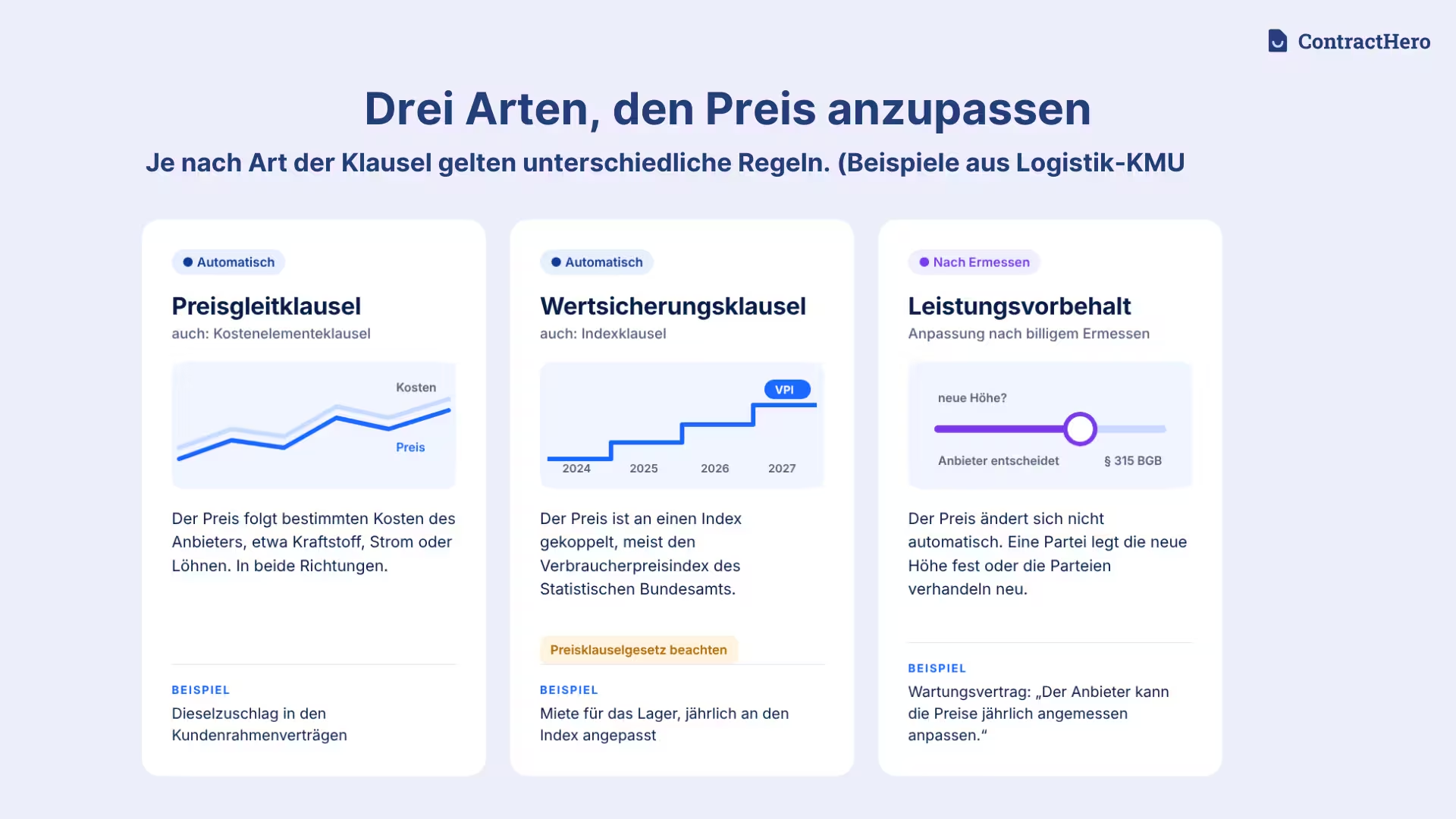
In addition, there are price adjustment clauses that link the price to the price of similar services.
For index clauses linked to an index, the Price Clause Act also applies. It generally prohibits automatically linking a monetary obligation to the price of goods that are not comparable. Reservations of performance, spread clauses, and cost-element clauses are exempt from this provision. Linking a debt to the consumer price index is permissible, among other cases, in contracts with a term of at least ten years or in which the creditor waives the right to ordinary termination for at least ten years. Pursuant to § 8 PrKG, a violation renders the clause invalid only once it has been legally established, unless the parties have agreed otherwise.
Typical Price Adjustment Clauses by Contract Type
Which clause is standard depends heavily on the type of contract. For the contracts of our logistics service provider, the situation is as follows.
Customer framework agreements with a diesel surcharge: A price escalation clause—often called a “diesel floater”—is common. It links a portion of the freight rate to a published diesel price and is considered a cost-element clause because fuel directly affects a transportation company’s cost of goods sold. Make sure there is a fixed base value, specify the proportion of fuel costs in the total price, and ensure that falling diesel prices are also passed on.
Lease Agreement for Storage Space: In commercial lease agreements, it is common to include a value protection clause linked to the consumer price index. Under the Price Clause Act, such a clause is permissible, among other things, if the lease term is at least ten years or if the landlord waives the right to terminate the lease for that period. You should also check whether the rent changes automatically or only upon request, at what index change the adjustment takes effect, and to which base year the index refers, as the Federal Statistical Office regularly adjusts it to a new base year.
Electricity Supply Contract: It is common to find clauses that pass on changes in taxes, fees, surcharges, and grid fees to the customer, sometimes combined with a link to market prices. It is important to specify exactly which price components may be adjusted and whether reductions—such as when a surcharge is eliminated—are also passed on. Also be sure to note the date until which an agreed-upon fixed price is valid.
Software Subscription: These often include a reference to the provider’s current price list or a link to the consumer price index, sometimes with a fixed markup. A reference to the price list gives the provider a lot of leeway, and automatic indexation for short contract terms may violate the Price Clause Act. Check the notice period and cancellation options, especially if the contract renews automatically.
Maintenance Contract: A typical provision is a reservation of performance, under which the provider adjusts prices at its reasonable discretion, or a clause linked to changes in collectively bargained wages. The less the clause specifies the grounds and criteria for such adjustments, the more important it is to review the specific increase in accordance with Section 315 of the German Civil Code (BGB). In the case of wage clauses, it should be clear what portion of the price is attributable to labor costs.
An Overview of the New Rulings
In 2026, the Federal Court of Justice (III ZR 205/25) and the European Court of Justice (C-669/24) reviewed price adjustment and amendment clauses in consumer contracts, drawing on different legal bases in the process.
Federal Court of Justice (BGH), III ZR 205/25: Lack of transparency renders the clause invalid
On October 1, 2026, the Federal Court of Justice (III ZR 205/25) ruled on the terms and conditions of an online subscription that included, among other things, product shipping and streaming. According to Section 5.2 of the terms and conditions, the provider was permitted to adjust the membership fee at its reasonable discretion in order to pass on cost increases. Section 5.3 set forth the procedure: notice must be given in writing at least 30 days in advance; customers have the right to reject the change; consent is deemed to have been given in the absence of a response; and customers also have the right to cancel the subscription free of charge. In its email regarding the 2022 price increase, the provider then presented the matter as if customers could only reject the increase by canceling their subscription.
The Federal Court of Justice (BGH) considers the clauses to be non-transparent and therefore invalid under Section 307(1) of the German Civil Code (BGB). They can be interpreted in two ways: as a unilateral right to change prices, leaving customers with no option but to terminate the contract, or as a provision under which a simple objection prevents the price increase. This ambiguity places customers at an unreasonable disadvantage.
The practical lesson: It is not enough that individual components of a clause might be permissible on their own. What matters is whether the contracting party can clearly understand what rights it has if the price increases.
ECJ, C-669/24: The right to terminate does not replace a fair clause
The case brought by the Federal Association of Consumer Organizations against Vodafone concerned a clause in the general terms and conditions under which the provider reserved the right to unilaterally amend the terms of the contract. Vodafone invoked Section 57(1) of the Telecommunications Act (TKG), which grants customers a special right of termination in the event of contract amendments. The Higher Regional Court of Düsseldorf sought a ruling from the European Court of Justice (ECJ) on whether the underlying EU provision, Article 105(4) of Directive (EU) 2018/1972, grants providers themselves the right to make such changes.
The European Court of Justice (C-669/24) ruled against this on September 10, 2026. The provision governs only the customers’ right to terminate the contract. Whether and under what conditions a provider may reserve the right to unilaterally amend the terms is governed by EU and Member State consumer protection law, in particular the Unfair Terms Directive 93/13/EEC. Such a clause must satisfy the requirements of good faith, balance, and transparency. The right to terminate is an additional requirement; it does not replace these requirements. The Higher Regional Court of Düsseldorf will now decide whether the Vodafone clause is valid under German law governing standard terms and conditions.
Does this also apply between companies?
Not directly. Both rulings concern consumer contracts, and the Unfair Terms Directive protects only consumers. However, Section 307 of the German Civil Code (BGB) also applies to general terms and conditions between businesses, and thus the requirement of transparency. The prohibitions on certain terms set forth in Sections 308 and 309 of the BGB—such as those regarding short-term price increases—do not apply directly to businesses under Section 310(1) of the BGB. In addition, courts take into account the customs and practices of commercial transactions in such cases.
What this means for a specific contract depends on the individual case. It is not possible to make a blanket statement that a price adjustment clause in B2B contracts is invalid based on these court rulings. However, the rulings demonstrate how closely courts scrutinize whether a clause clearly defines the grounds, scope, and rights of the contracting party. For companies, this signals that they should expect stricter standards regarding transparency even for B2B clauses.
For our logistics service provider, this means that the framework agreements with its customers are B2B contracts, so its diesel surcharge is not covered by the court rulings. However, if the clause is worded ambiguously—for example, without a fixed benchmark or a provision for falling diesel prices—this poses a risk that the provider should be aware of and assess.
How to Spot a Risky Clause (Checklist)
The following checkpoints help the legal department and the purchasing department identify critical clauses. A match does not automatically mean that a clause is invalid, but it does indicate where a more detailed review is warranted.
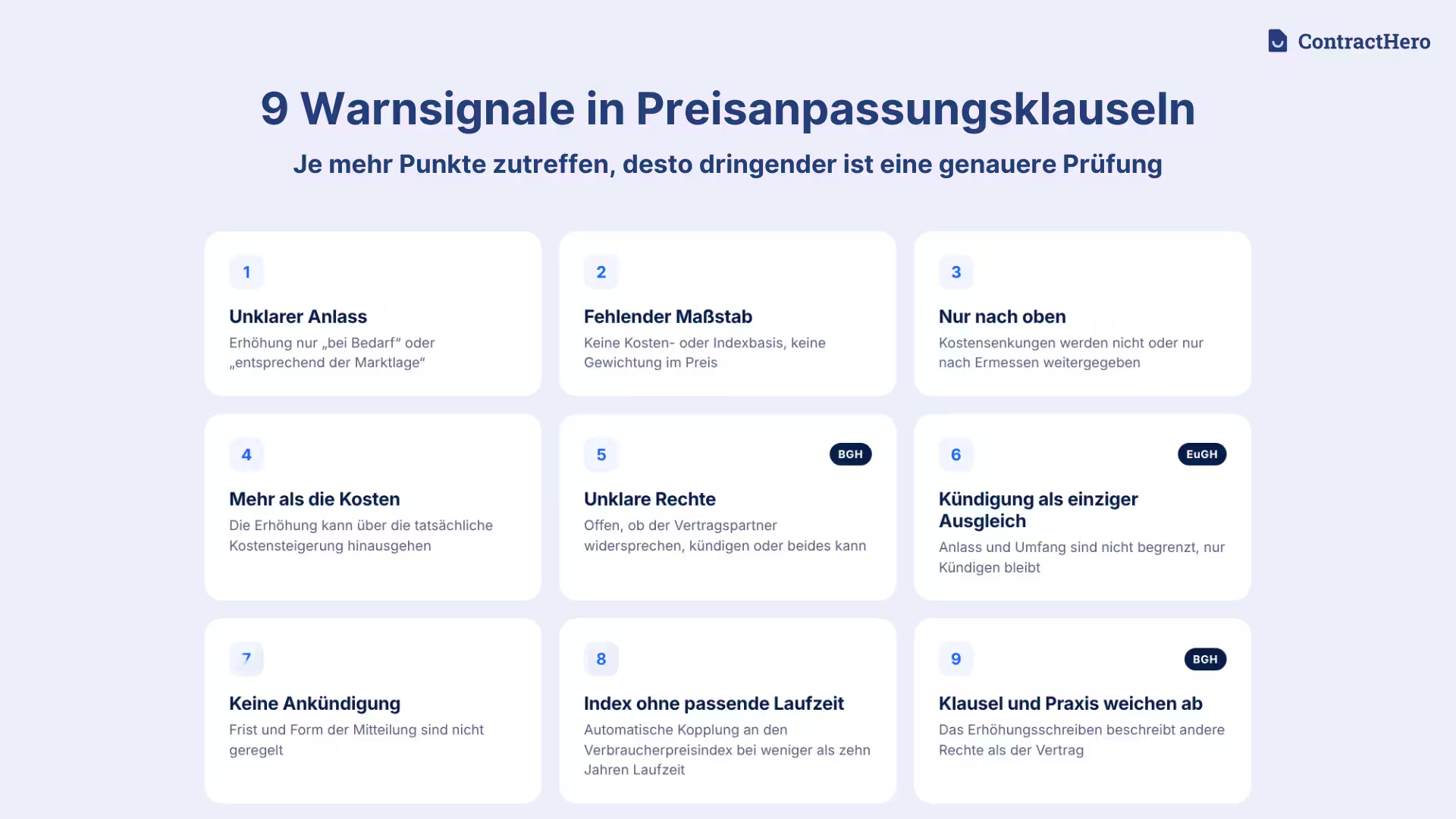
Even a template for a price adjustment clause does not replace this review. The clause must be tailored to the specific contract, the cost structure, and the term.
How to Review Your Entire Contract Portfolio
The review becomes difficult when dealing with hundreds of contracts whose price adjustment clauses are contained in different versions of the general terms and conditions, attachments, and addenda. A three-step approach has proven effective: Identify contracts containing price adjustment clauses, classify them by type and risk, and document the “ deadlines ” and responsibilities. You should treat your own contracts and supplier contracts separately, because in one case you are the party using the clause, while in the other you are the party subject to it.
Our Own Contracts: Customer Terms and Conditions and Framework Agreements
When it comes to your own contracts, the key is to be able to enforce price adjustments in a legally sound manner. If a clause is invalid, the basis for future price increases—and, under certain circumstances, even for those that have already taken place—may be lost.
First, determine which versions of the terms and conditions are in use and which customer has agreed to which version. Then compare each version against the checklist, paying particular attention to customers’ rights in the event of a price increase. Also review your templates for price increase letters. The Federal Court of Justice (BGH) case shows that the terms of the agreement and the communication must align.
During this review, our logistics service provider identifies three versions of the general terms and conditions. The oldest version lacks a provision addressing falling diesel prices, and the relationship between objections and termination is left undefined. The legal department revises the clause, and the sales department uses upcoming contract renewals to agree to the new version.
Supplier Contracts: Where You Can Challenge Price Increases
When it comes to purchasing, the situation is the opposite. If a supplier announces a price increase, it’s worth checking whether the contract even allows for it. Without a contractual basis, a supplier generally cannot unilaterally raise the price.
If there is a clause, check whether the increase complies with it: reason, amount, basis for calculation, notice period, and form. In the case of a reservation of the right to adjust rates at reasonable discretion, the specific increase may also be reviewed for reasonableness under Section 315 of the German Civil Code (BGB). deadlines are important. If the contract provides for a right of objection or a special termination, these deadlines typically take effect upon receipt of the notice. The article on automated deadline management shows how to reliably monitor such deadlines . You can find the basics on notice period can be found in the glossary.
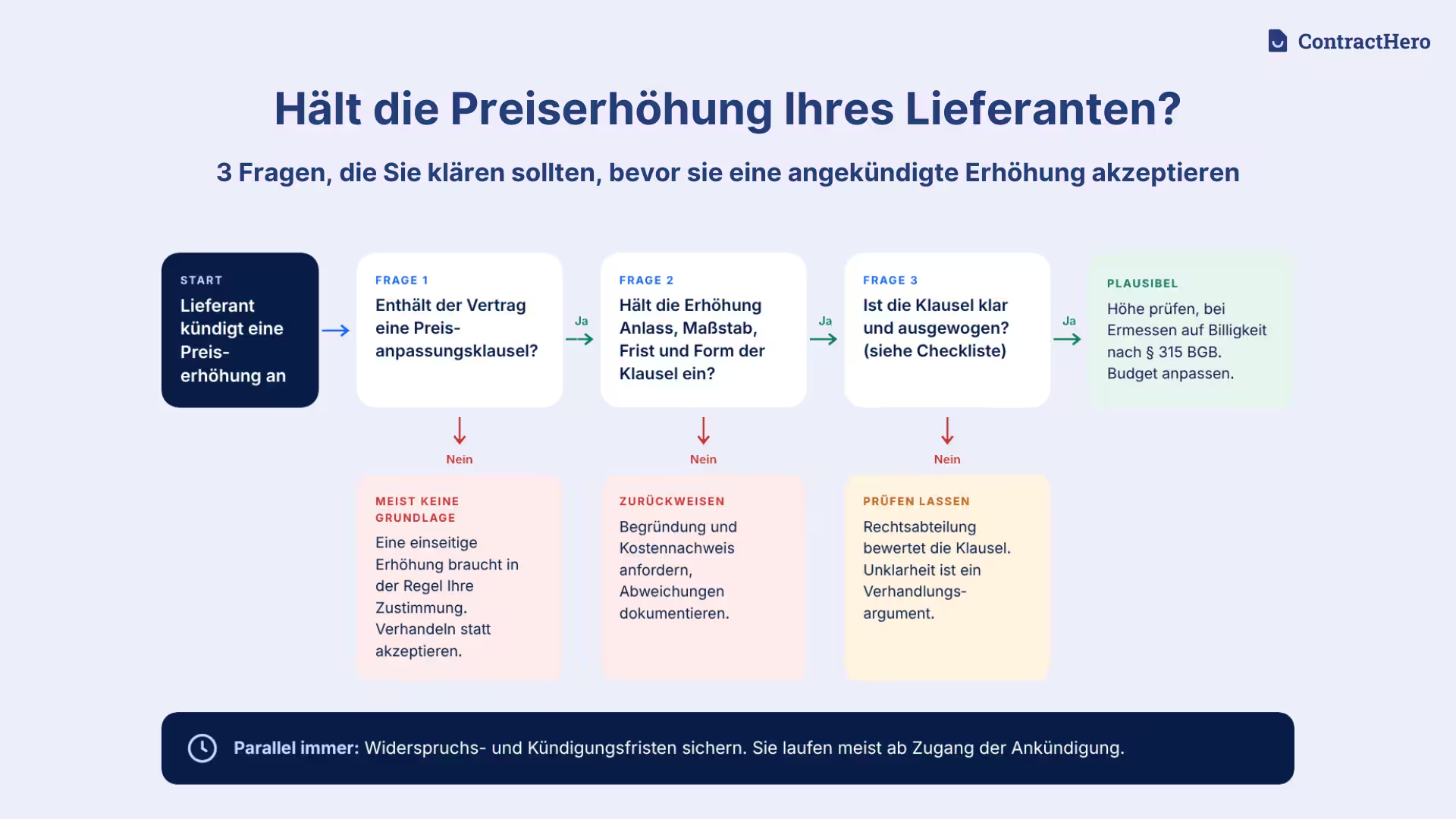
Our logistics service provider has been notified by the maintenance provider of a 9 percent price increase. The clause allows for a “reasonable” adjustment but does not specify a standard. The purchasing department is requesting an explanation for the cost increase, and the legal department is evaluating the clause. It is impossible to predict with certainty whether it is invalid in a B2B context. Nevertheless, the unclear wording is a valuable argument in the negotiations.
How " contract management" Software Can Help
The biggest hurdle is maintaining an overview, because price adjustment clauses are named differently in every contract and are often found in attachments or the terms and conditions. Contract management software ( contract management) makes them searchable across your entire portfolio. The AI analysis captures contracts in a structured way and highlights relevant clauses. Using the AI assistant, you can ask questions across all contracts, such as “Show all contracts with an index clause.” This quickly generates a list of contracts that should be reviewed.
The second level consists of contract metadata and deadlines. The type of clause, notice period, and objection period can be recorded in the contract. You create tasks for the review when you upload and analyze the contract, and assign them to a responsible person. The deadline itself then triggers the reminder.
Our logistics service provider can see at a glance which of its 400 contracts contain a price adjustment clause, which are linked to an index, and when objection periods are in effect for supplier contracts. The legal department prioritizes customer terms and conditions, while the purchasing department prioritizes supplier contracts with the highest volumes.
Conclusion
Price adjustment clauses determine whether you can pass on cost increases and whether price increases by your suppliers are justified. The rulings by the Federal Court of Justice (BGH) and the European Court of Justice (ECJ) concern consumers, but they demonstrate how closely courts scrutinize transparency: A clause must clearly define the grounds, criteria, and rights of the contracting party, and a right of termination does not compensate for ambiguities.
That is why it is crucial to have a clear overview of your own portfolio. If you know which contracts contain which clauses and which deadlines are active, you can tailor your terms and conditions accordingly and thoroughly evaluate price increases, rather than reacting under time pressure.
Would you like to see how to find price adjustment clauses throughout your entire contract portfolio? Schedule a demo or get started right away with the Starter Plan.
(This article is not a substitute for legal advice; as of November 2026)