Anyone looking for contract management ( Contract Management) software will quickly find themselves faced with a bewildering array of options: specialized tools, all-in-one platforms, cloud-based solutions, and on-premises systems. Every provider promises transparency, automation, and time savings. But which solution is truly the right fit for your company? The answer depends less on individual features than on contract volume, existing systems, security requirements, and the processes that actually need to be mapped. In this article, you’ll learn what criteria to use to effectively compare providers and which solution is best suited for which type of business structure.
Why " Contract Management " Must Go Digital Today
Contract Management manages core business processes and forms the basis for financial obligations, risks, and operational dependencies. Nevertheless, the current situation is often inefficient. Contracts are scattered across emails, local folders, or individual systems.
This gives rise to specific challenges in day-to-day operations. Without a structured Contract Management there is a lack of transparency regarding terms, costs, and obligations. This leads to missed cancellation deadlines, unnecessary renewals, and additional coordination efforts.
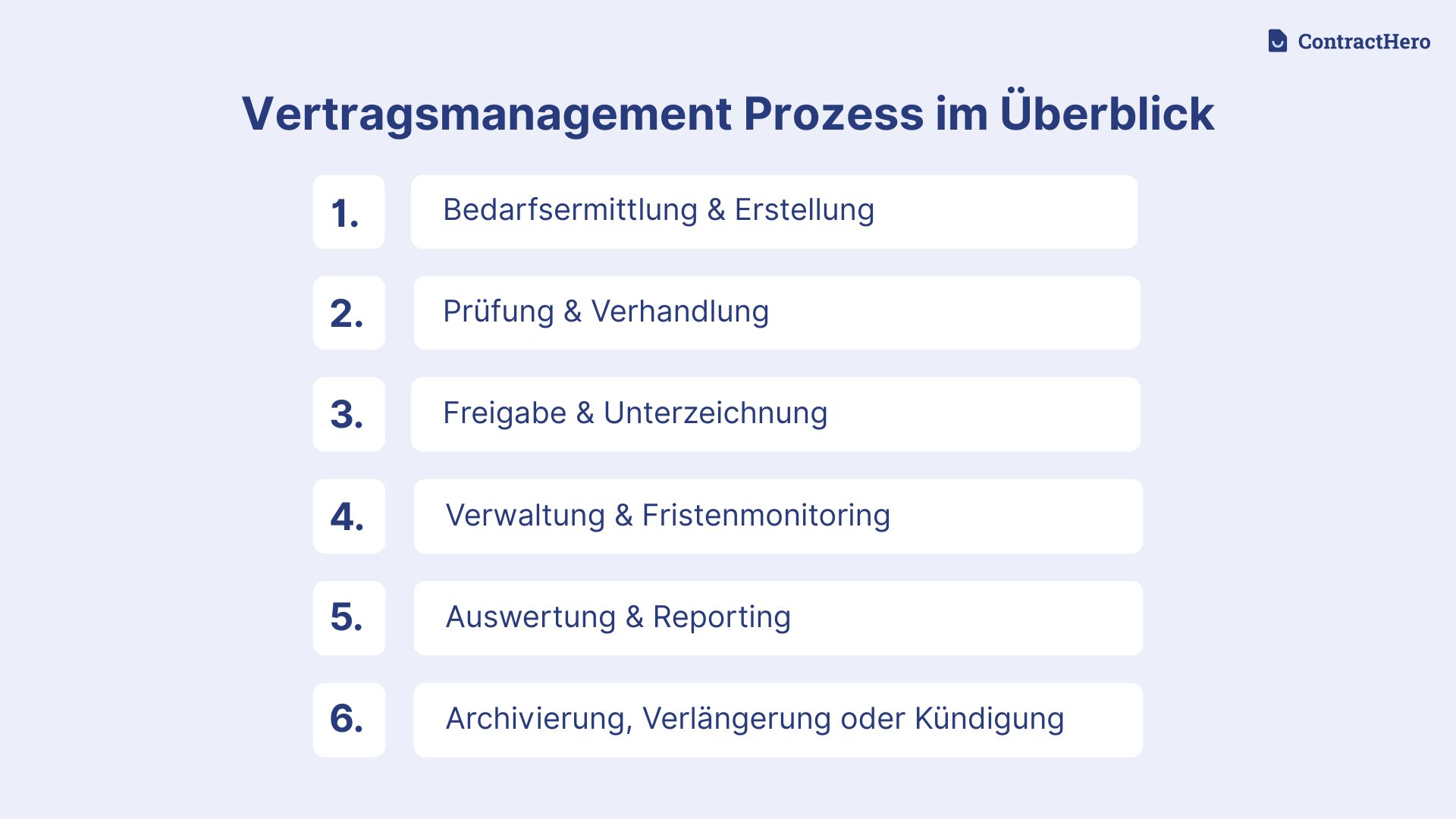
A digital " Contract Management " provides a structured foundation here. Contracts are centrally recorded, managed throughout their entire lifecycle, and systematically analyzed. Automated deadline tracking, clear responsibilities, and contract data available at all times ensure transparency and control in day-to-day operations.
Contract Management It is thus evolving from an administrative task into a manageable, company-wide process.
A Comparison of Providers of " Contract Management" Software
The market for “ Contract Management ” software providers is vast and complex. Companies are faced with a wide variety of solutions, each with different focuses and target audiences. The differences lie less in individual features than in structure, integration capabilities, and areas of application. A clear comparison is essential for identifying the right solution.
What are some providers of " Contract Management" software?
Various approaches have become established in the market for Contract Management software providers. Providers can generally be distinguished based on how the software is operated and the range of functions it covers. A key distinction lies between cloud-based Contract Management software and on-premises solutions. At the same time, providers differ in whether they specialize in Contract Management or operate as part of comprehensive platforms. This classification forms the basis for a structured comparison.
Cloud-based vs. On-Premise Solutions
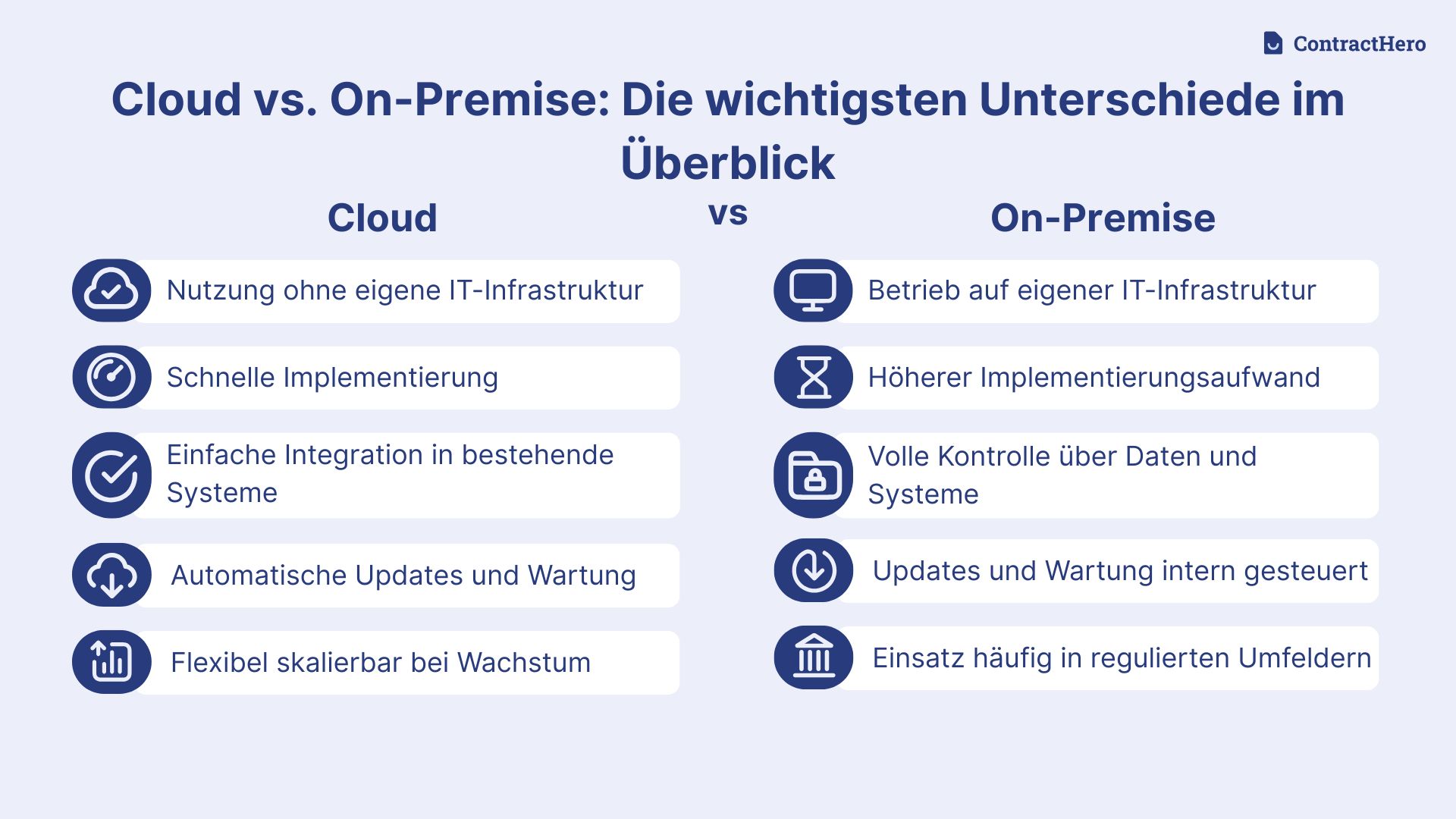
Cloud-based Contract Management software has become the standard in recent years because it does not require any in-house infrastructure and can be implemented much more quickly. Solutions such as ContractHero, DocuSign CLM, and fynk are centrally managed, can be scaled flexibly, and integrate easily with existing systems. Updates occur automatically, without tying up internal IT resources. This approach offers clear advantages in terms of speed and operations, especially for growing companies.
On-premises solutions, on the other hand, are operated locally on the company’s own infrastructure. They offer greater control over data and systems, but require more effort to implement and maintain. Customizations and updates must be managed internally and implemented by the company’s own IT resources.
In practice, most companies opt for cloud-based Contract Management software because it is ready for use more quickly and integrates more easily into existing system landscapes. On-premises solutions, however, remain relevant, particularly in highly regulated environments where there are specific requirements regarding data control and infrastructure.
Specialized Providers vs. All-in-One Platforms
Contract Management Software differs not only technically but also in its fundamental approach. The key factor is the importance given to contract processes within the solution. Specialized Contract Management software is fully geared toward these processes. Contracts are recorded in a structured manner, deadlines automatically monitored, and responsibilities clearly assigned. Reports on terms, costs, or obligations are thus immediately available. The goal is to map Contract Management as a standalone and controllable process.
All-in-one platforms take a broader approach. Contract Management is just one module within a larger software solution, such as an ERP or document management system. While contracts are managed as part of the system, they are not the primary focus. Features such as deadline tracking or reporting are often less robust or must be supplemented on a case-by-case basis.
The difference lies in the details. While specialized solutions are designed with structure and control in mind, platforms primarily offer integration. Which option makes sense depends on how central Contract Management is to the company.
Criteria for Selecting the Best Contract Management Software
Choosing the right Contract Management software depends on a company’s specific needs. However, there are general criteria that should be considered regardless of industry or company size. These criteria determine whether a solution will work effectively in day-to-day operations over the long term and be used consistently.
The central question is how well Contract Management can be integrated into existing structures and processes. Depending on the initial situation, the focus may vary—for example, on control, efficiency, or compliance.
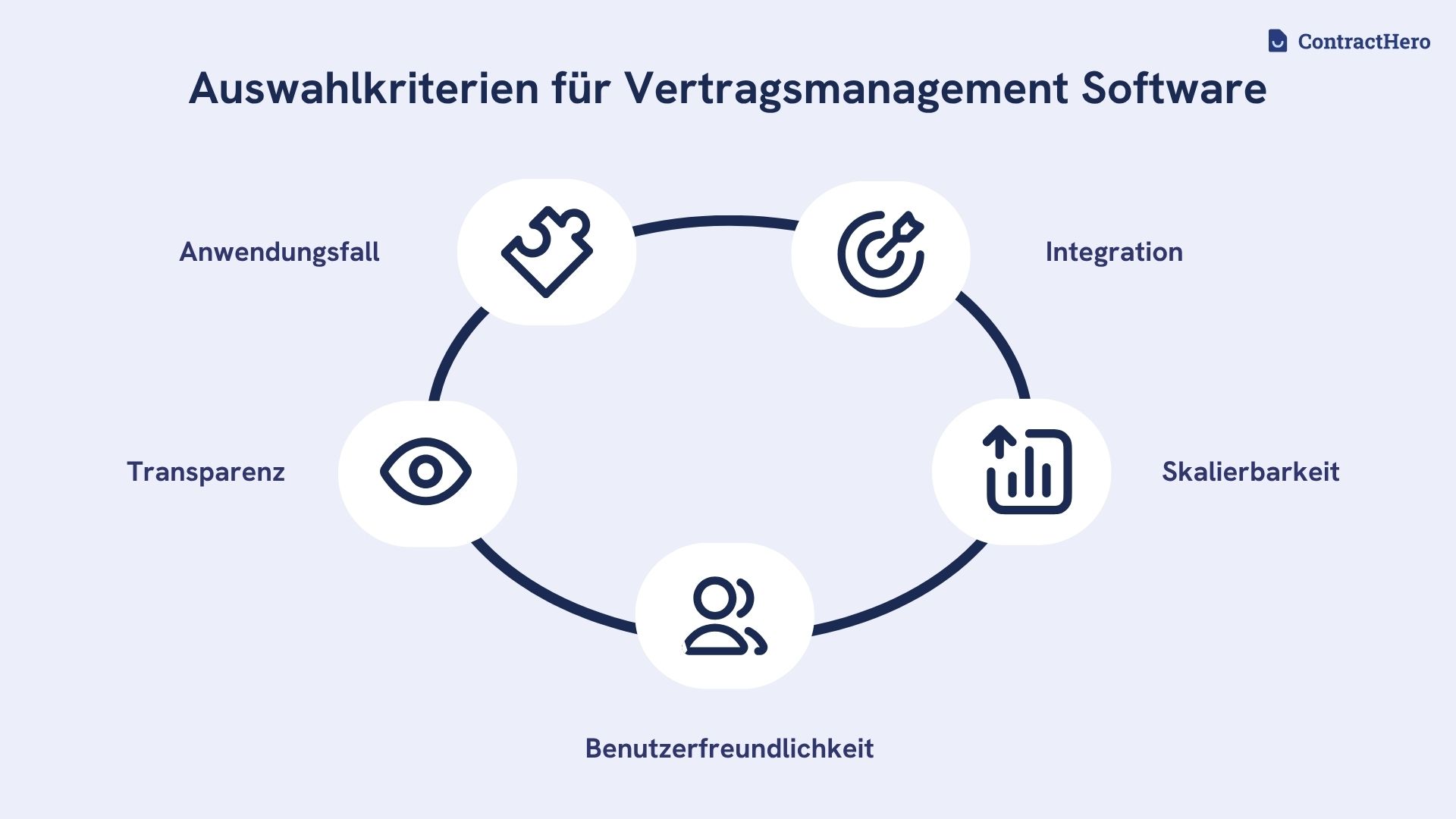
Key criteria include:
- Suitability for the use case
The software should address the company’s specific requirements, such as contract volume, complexity, or regulatory requirements. - Integration into existing systems
Seamless integration into existing IT environments is essential for end-to-end processes. - Flexibility and Scalability
The solution should be able to adapt to changing requirements and grow alongside the company. - User-friendliness and Acceptance
Software will only be used consistently if it is intuitive and easy to navigate in day-to-day work. - Transparency and Traceability
Contract data and processes should be clearly structured and traceable at all times.
These criteria help to properly classify " Contract Management " software not only in functional terms but also from a strategic perspective.
Benefits of Professional " Contract Management " Software
Contracts are a constant part of everyday business life. At the same time, companies often lack the necessary overview to reliably manage obligations, costs, and risks. This is exactly where professional Contract Management software comes in.
The key advantage lies in transparency. Contracts are no longer managed decentralizedly but are mapped within a unified structure. Contract terms, deadlines , and responsibilities are traceable and available at any time. This lays the foundation for well-informed decisions and reduces operational uncertainties.
Building on this, the way processes are handled is also changing. Tasks such as monitoring deadlines or locating relevant information are no longer performed manually, but rather in a structured and consistent manner. Coordination between departments is reduced, as all stakeholders have access to the same data.
As usage increases, another effect emerges. Contract data becomes analyzable and provides insights into cost structures, interdependencies, and risks. As a result, “ Contract Management ” evolves from an administrative task into a robust basis for management decision-making.
The added value, therefore, lies not in individual features, but in the combination of transparency, structure, and reliability when handling contracts.
Software Comparison: Features and Highlights in Detail
A comparison of " Contract Management " software shows that many providers offer basic features such as contract storage, deadline management, and workflows. The key differences lie in the depth, automation, and focus of the solution—for example, in terms of integrations, reporting, or support for complex processes.
When making a selection, therefore, what matters most is not whether certain features are available, but how they can be applied in the specific context. The target audience, implementation effort, and the focus of the solution are particularly relevant.
Below is an overview of five leading Contract Management software providers and their typical areas of application:
ContractHero
ContractHero is specialized contract management software ( Contract Management) designed for German and European small and medium-sized businesses, with a strong focus on transparency, deadline tracking, and governance. The solution combines automated contract analysis (including OCR and AI) with clear role and permission structures, as well as integrations with existing systems. It stands out for its combination of rapid implementation, high usability, and, at the same time, in-depth control capabilities for finance, procurement, and legal departments.
Contractbook
Contractbook is a cloud-based Contract Management platform focused on document creation, e-signatures, and centralized storage. With its intuitive interface, the solution is primarily aimed at smaller teams and growing companies. It places less emphasis on a comprehensive governance structure for finance and procurement teams at medium-sized businesses.
DocuSign CLM
DocuSign CLM is part of a globally established platform and covers the entire contract lifecycle. The solution offers extensive integrations and is designed for large, multinational companies. Its feature set is correspondingly broad, but this can come with greater implementation effort and more complex operational structures.
Ironclad
Ironclad is an internationally renowned CLM platform that focuses heavily on legal operations and workflow automation. The software offers flexible process design and is particularly well-suited for larger, globally active companies. For mid-sized organizations, however, its feature set may seem excessive.
PandaDoc
PandaDoc is frequently used in sales and is best known for creating quotes and electronic signatures. The solution enables fast, standardized document workflows and is easy to use. However, its feature set is more limited when it comes to traditional e- Contract Management , which focuses on deadlines, risks, and governance.
This selection highlights typical differences in the market. While some solutions focus on enterprise complexity or e-signatures, others specifically address structured contract management or AI-powered analysis.
Which “ Contract Management ” software is the right choice therefore depends less on individual features and more on how well the solution fits your own processes and can be used in day-to-day operations.
AI features are transforming the world of contracts
AI is becoming increasingly important in the context of " Contract Management " software. Modern solutions use AI to automatically analyze contract content, extract relevant data, and identify risks early on. This reduces manual effort and speeds up processing, even when dealing with large volumes of contracts.
Typical use cases include extracting contract clauses, identifying deadlines , or the structured classification of documents. This ensures that contract data is consistently available and analyzable.
However, the actual value added depends heavily on the data foundation. AI functions can only be effectively implemented and reliably utilized if contracts are recorded in a structured manner and maintained accurately. Without this foundation, many results remain inaccurate or still require manual follow-up work.
Integration with existing business software
Contract Management Software only realizes its full potential when it works in tandem with existing systems. Contracts do not exist in isolation; rather, they are closely linked to processes in finance, legal, procurement, and sales. Without integration, this leads to data inconsistencies, duplicate data entry, and additional reconciliation efforts.
Modern solutions therefore rely on standardized interfaces and flexible integrations. Typical connections include ERP, CRM, and accounting systems, as well as tools such as e-signature solutions and cloud storage. Contract data—such as terms, costs, and deadlines —is thus made available wherever it is needed in day-to-day operations.
Another key consideration is scalability. As a company grows, so do the demands placed on its system landscapes and data flows. Contract Management Software must integrate seamlessly into these structures and remain flexibly expandable without introducing additional complexity.
The difference lies in the details. Solutions designed for easy integration and clear data structures can be incorporated into existing processes much more quickly and provide a consistent foundation for cross-departmental collaboration.
How much does a professional Contract Management solution cost?
The cost of " Contract Management " software varies widely and depends on several factors. These include the scope of features, company size, number of users, and integration requirements. It is therefore difficult to make general statements about pricing.
In practice, many solutions are based on a SaaS model. Billing is typically based on a per-user basis or on the contract volume. Entry-level solutions often cost in the low four-digit range per year, while more comprehensive solutions for larger companies can cost significantly more.
In addition to the pure licensing costs, implementation and ongoing operations should also be taken into account. This includes, for example, migrating existing contracts, setting up systems, and providing training for employees. Depending on the complexity, these costs can vary significantly.
Therefore, it is not just the price that matters, but the cost-benefit ratio. Structured Contract Management software reduces manual effort, mitigates risks, and creates transparency. In many cases, savings are not generated by the software itself, but rather through improved contract management.
Conclusion: Choosing the right " Contract Management " software is a strategic decision
The market for “ Contract Management ” software providers is diverse, but the differences lie not solely in the range of features. What matters most is how well a solution works in day-to-day operations, how well it integrates into existing processes, and whether it actually enables users to manage “ Contract Management .”
Many companies underestimate the importance of structure. Without a clear data foundation, defined processes, and consistent use, even high-performance software fails to reach its full potential. At the same time, experience shows that solutions are particularly effective when they can be implemented quickly, used intuitively, and integrated flexibly into existing system landscapes.
This is exactly where solutions like ContractHero come in. The focus is on a clear structure, ease of use, and seamless integration into existing processes. This not only digitizes " Contract Management ," but also makes it truly usable and manageable in everyday life.
The selection should therefore not be based solely on features. The key factor is which solution is the best fit for your company and will be used in day-to-day operations over the long term. By implementing Contract Management in a structured way, you create transparency, reduce risks, and gain control over key business processes.