
Contracts specify what a company must pay in the coming months and years. For the CFO, they are therefore more than just documents: they represent predictable payments, opportunities to exit, and data for the annual financial statements. This guide from ContractHero explains what contract data the finance department needs and how it can use that data for liquidity management, budgeting, and financial reporting.
contract management For CFOs, this means centrally recording the amount, payment frequency, term, termination date, and cost center for each contract. This information is used to generate the payment schedule for cash flow planning, the committed volume per cost center for budgeting, and the details regarding other financial obligations in the annual financial statements. Reminders sent before each termination date prevent contracts from being unintentionally extended. contract management software such as ContractHero handles data entry, reminders, and export to planning tools.
Why are contracts a financial issue?
Contracts are a financial issue because a large portion of operating expenses is specified in them. Rent, leases, software licenses, maintenance, and service providers often tie up budget funds for several years. If you are not fully aware of these obligations, your planning will have gaps.
In many companies, contracts are scattered across departments, mailboxes, and file folders. The finance department sees the invoice but not the contract term or the notice period associated with it. This results in avoidable costs: contracts are unintentionally renewed, licenses are paid for twice, and contractual price increases aren’t noticed until the higher invoice arrives.
Reducing contract costs, therefore, starts with getting a clear overview, not with negotiation. Only once it is clear which contracts are in effect and how much they cost can you strategically terminate, bundle, or renegotiate them.
An example will guide you through this guide: a software contract for €2,400 per month, paid annually in advance. It runs through December 31, 2027, automatically renews for twelve months, and can be terminated with three months’ notice prior to the end of the term. If the provider does not receive notice of termination by September 30, 2027, the contract will continue through December 31, 2028. This will cost an additional €28,800 (12 × €2,400, before any possible index adjustment), even if the software is no longer needed.
What contract information does the finance department need?
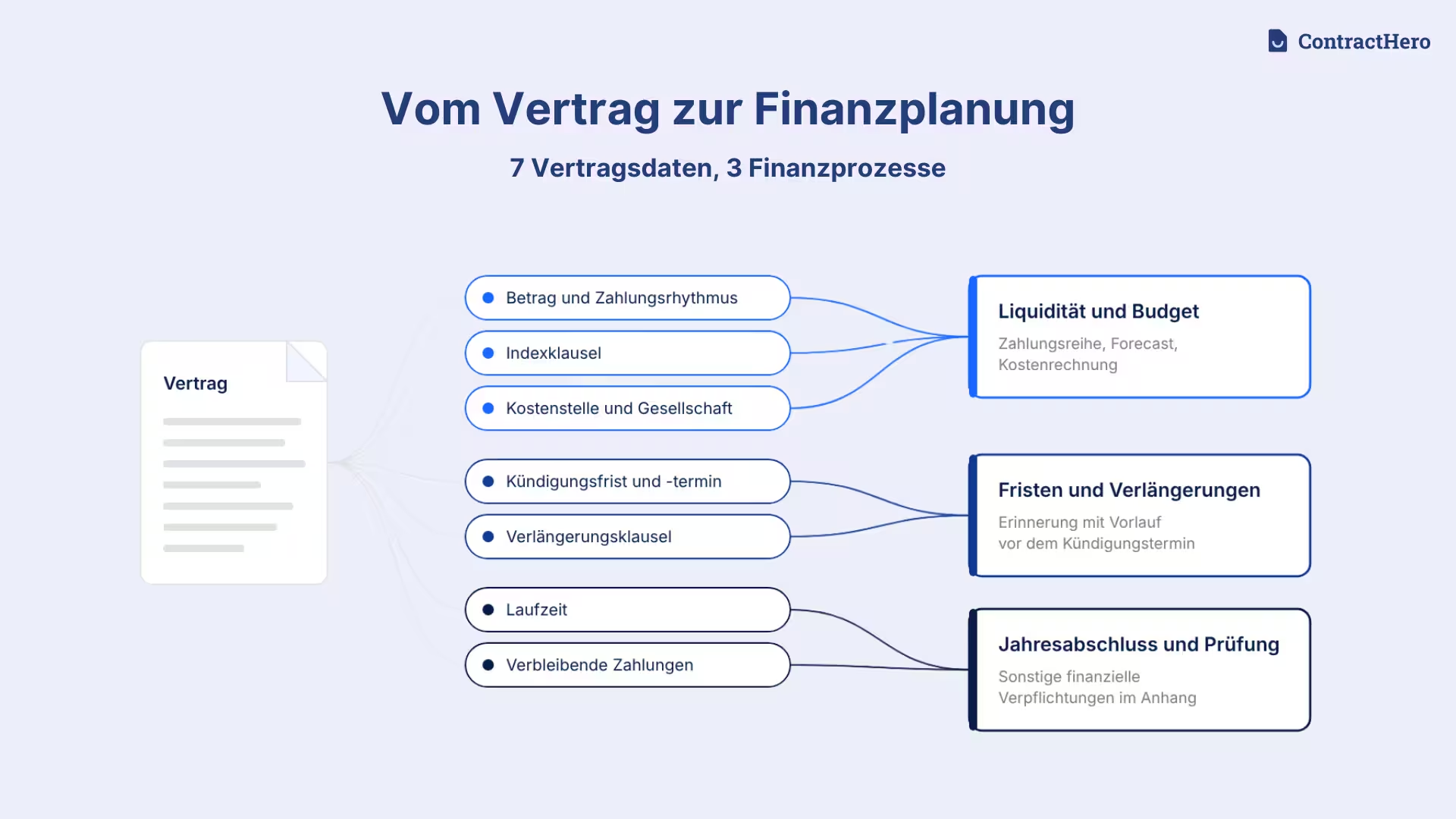
The finance department needs the data from each contract that triggers a payment, a deadline, or an entry in the financial statements. For most financial processes, seven data points are sufficient. Maintained centrally in the contract registry, they form the shared data foundation for the finance and legal departments.
| Contract Date | Financial Process | Sample Software Agreement |
|---|---|---|
| Amount and Payment Frequency | Liquidity Planning, Budget | 2,400 € per month, paid annually in advance: 28,800 € in January |
| Duration | Medium-Term Planning, Annual Financial Statements | through December 31, 2027 |
| notice period and termination date | Avoiding Unintended Extensions | Three months before the end of the term; notice of termination must be received by September 30, 2027 |
| Renewal Clause | Budget for Subsequent Years | automatic renewal for twelve months |
| Index Clause | Cost Forecast | Annual adjustment based on the Consumer Price Index (CPI) |
| Remaining Payments | Forecast, other financial obligations in the notes to the financial statements | As of December 31, 2026: €28,800 until maturity |
| Cost Center and Company | Cost Accounting, Group View | IT Cost Center, Subsidiary B |
Anyone who has to manage multiple companies should make "Company" a required field. This is the only way to accurately analyze obligations later on for each individual financial statement.
How is contract data incorporated into liquidity planning?
Contract data is incorporated into liquidity planning once the amount, payment frequency, and due dates for each contract have been entered in a structured manner. This information generates a payment schedule that can be directly imported into the planning process. As a result, contracts appear in liquidity planning before the first invoice is received. In the example, this means the following: In January 2027 (payment date), €28,800 will be paid out; after that, there will be no further payments for this contract until the end of the year.
Indexation clauses deserve special attention. They cause amounts to change over the term of the contract, often once a year. If you know the adjustment date and the benchmark, you can estimate the increase and plan for it in advance, rather than noticing it only when you receive the bill. In the example, with a 3 percent adjustment, the amount would already be €29,664 by 2028.
To ensure that no one has to manually enter data, it should be exportable—for example, as an Excel or CSV file, or via an interface to a reporting tool. MMB Velbert analyzes contract data through its integration with Power BI by time period, contract partner, and cost type. According to the success story, the company has since been able to plan its liquidity with about 25 percent greater accuracy. The new transparency also helped the company save money: by cutting back, renegotiating, and terminating contracts, contract costs fell by about 20 percent.
How do you use contract data for budget planning?
For budget planning, use contract data by analyzing the contract volume by cost center. This total shows each department, prior to the budget cycle, how much of the budget for the planning year is already contractually committed. Only the remaining amount is available for new projects.
In the example, €28,800 has already been allocated to the IT cost center for 2027. The amount for 2028 is still undecided: If the contract is not terminated by September 30, 2027, another €28,800 will be incurred; with a 3 percent index adjustment, the amount will be €29,664. In many companies, the 2028 budget cycle takes place in the fall of 2027, which coincides with the period around the cancellation deadline. Therefore, decisions regarding the contract and budget planning go hand in hand.
For the budget review, an overview for each cost center with three values is sufficient:
- Committed Contract Volume: All payments in the budget year from contracts that can no longer be terminated.
- Terminable contracts: Contracts that can be terminated before or during the budget year. This determines whether funds are released.
- Expected price adjustments: Increases resulting from indexation or graduated pricing clauses.
This requires that the cost center and company be maintained for each contract. Then, the business unit and the finance department can use the same data source to see where the budget is committed and where there is flexibility.
How can you prevent automatic contract renewals?
You can avoid automatic contract renewals by keeping track of the cancellation deadline—not just the notice period. The notice period specifies how far in advance notice must be given. The cancellation deadline is the specific date by which the notice of cancellation must be received by the other party to the contract. In the example, this is September 30, 2027.
Anyone who wants to reduce contract costs needs to take advantage of this deadline. If it passes without action, the company in the example will pay €28,800 for another year without having made a new decision.
Be sure to allow plenty of time before this date. Decisions regarding termination, renewal, or renegotiation require usage data, comparative offers, and often internal approval. In the example, the first reminder is therefore sent in mid-August 2027, about six weeks before the deadline. Every contract also requires a designated contact person and a designated substitute. Our article on this topic explains how these steps can be automatically monitoreddeadlines . You can find the basics in the glossary under “Deadline Management.”
Legal Note: Section 309(9) of the German Civil Code (BGB) limits implied extensions in general terms and conditions. This limitation applies only to consumers. Section 309 of the BGB does not apply directly to businesses (Section 310(1) BGB). Extensions of one year or longer are therefore not uncommon between businesses.
What do contracts have to do with the annual financial statements?
Contracts provide information for the annual financial statements that is not directly reflected in the accounting records. Three points are particularly relevant for the CFO.
Other Financial Obligations in the Notes to the Financial Statements: Corporations and limited-liability partnerships, such as GmbH & Co. KG, disclose in the notes to the financial statements the total amount of other financial obligations not included in the balance sheet, provided that this amount is material to the financial position (Section 285 No. 3a HGB). Typical examples include future payments arising from rental, lease, and service agreements. Small corporations are not exempt from this requirement (Section 288 HGB); micro-corporations may, under certain conditions, omit this information from the notes to the financial statements (Section 264(1), sentence 5, HGB). In the example, the remaining €28,800 as of December 31, 2026, is included in this total.
Provisions for Impending Losses: If a contract is expected to cost more than it will generate in revenue, a provision for impending losses must be recognized in the commercial balance sheet (Section 249(1) of the German Commercial Code (HGB)). This may apply, for example, to leased space that is no longer in use. This provision is not tax-deductible (Section 5(4a) of the German Income Tax Act (EStG)).
Leasing under IFRS 16. Entities that prepare financial statements in accordance with IFRS generally recognize lease agreements under IFRS 16 as a right-of-use asset and a lease liability on the balance sheet, with exceptions for terms of up to twelve months and low-value assets. Under the German Commercial Code (HGB), leases are often off-balance-sheet and are classified as other financial obligations. Rental agreements (e.g., for office space) also fall under this category.
For more information, see " Preparing Financial Statements " and the " Financial Statements and Audit" page.
Which key performance indicators should be included in contract management?
Contract management includes key metrics that show contract costs, commitment levels, and the controllability of the contract portfolio. For the CFO, five metrics—which can be updated roughly once a quarter—are sufficient.
- Annual contract volume: the total of all contractually obligated payments for a given year. It shows how much of the budget has already been allocated.
- Percentage of contracts with automatic renewal: This indicates where costs continue to accrue without an active decision.
- Decision Rate Before the Termination Deadline: the percentage of termination deadlines for which a decision was made in a timely manner. It indicates whether deadline management is effective.
- Contracts without a designated person in charge: They highlight gaps in responsibility and, as a result, pose risks related to deadlines.
- Savings from renegotiation: the difference between the old and new annual costs. This figure illustrates the financial return on contract management.
General key figures that are not directly related to finance can be found in the article " Key Figures" at contract management.
Is Excel sufficient for contract management?
For a small, manageable portfolio of contracts, Excel is sufficient for contract management. A well-maintained list of amounts, terms, and termination dates is significantly better than having no overview at all. However, as the portfolio grows, typical weaknesses become apparent.
- No reminder: A table does not automatically notify you when a cancellation deadline is approaching.
- No audit trail: It is nearly impossible to determine who changed an amount or a date and when. This leads to follow-up questions during the year-end audit.
- A maintenance process without safeguards: Often, only one person maintains the list. If that person is unavailable, updates are left undone.
- Duplicate data: Contracts, lists, and calendars become out of sync as soon as one source is not updated.
At the very least, when multiple departments or companies enter into contracts, the effort required for reconciliation and verification quickly outweighs the benefits of the table.
How does ContractHero support the finance department?
ContractHero centrally collects contract data and makes it available for planning, budgeting, and closing deals. When you upload contracts, the AI analysis identifies terms, notice periods, and renewals. You designate a responsible person for each contract, and workflows (starting with the Essential plan) automatically generate tasks and reminders based on this information. As a termination date approaches, ContractHero sends a reminder to the responsible person.
In Reporting (Professional and above), you can analyze costs, deadlines , and obligations, including using pre-built templates for financial reporting. You can export results to Excel or CSV, and through the Power BI integration (add-on available starting with the Essential plan), the data flows directly into your financial reports. A change log shows who changed which contract data and when. ContractHero is certified to ISO/IEC 27001:2022, and the data is hosted in data centers in Frankfurt am Main.
According to The Relevance Group, the investment paid for itself after just two months. Plans start at €129 per month with annual billing (pricing). Our cost guide shows the total cost of “ contract management ” software, and our ROI calculator estimates the potential benefits for your company. Read more at contract management for the finance department.
Checklist: " contract management " for CFOs
Use these eight points to check whether your contract management meets the requirements of the finance department.
Takeaway: Download the free Contract Registry Checklist directly from our white papers and checklists. It will help you organize your contract portfolio in a structured way.
Conclusion: Contract data makes costs manageable
For the CFO, contracts only become manageable once their data is complete and centralized in one place. Seven pieces of information per contract are sufficient to plan liquidity, allocate budgets realistically, and prepare the annual financial statements. The most important date in this context is not the contract’s expiration date, but the termination date. Until then, you decide whether costs will continue.
Start by taking stock: Identify all contracts with ongoing payments, assign them to a cost center and a responsible person, and check the termination dates for the next twelve months. As your portfolio grows, it’s worth investing in contract management software that monitors deadlines and provides the data needed for planning and closing.
This is not tax or legal advice. As of November 2026.