Local governments manage a wide variety of contracts: with service providers, suppliers, other public agencies, and private partners. Yet many local governments lack a centralized overview. Contracts are scattered across different departments, responsibilities are unclear, notice periods are missed, and the VAT classification of individual contractual relationships is difficult to track. A structured contract registry provides a solution. In this article, you’ll learn how local governments can set up a digital contract registry step by step, which mandatory fields it should include, and which tools offer the greatest benefit.
Introduction to the contract register for municipalities
A central contract register is an important organizational and management tool for local authorities. It helps to systematically record the large number of contractual rights and obligations and make them transparent across the administration. All contracts that a local authority concludes with external partners - such as service providers, companies or other public bodies - are collected in such a register. Ideally, information such as the contract partners, term, subject matter, payment flows, purpose and the classification of whether the contract is sovereign or entrepreneurial is recorded. This structured overview not only facilitates compliance with documentation obligations and retention requirements, but also a uniform VAT assessment.
Another important aspect is legal compliance: contracts that commit a municipality must generally be concluded in writing and signed by the authorized representatives - such as the mayor or other committee representatives. Only then are they effective and legally binding. A central contract register documents such formalities in a comprehensible manner and ensures that contracts are concluded and managed correctly.
The following section explains what such a contract register could look like.
Example of a municipal contract register
A central contract register can be implemented in very different ways - from a simple Excel spreadsheet to a specialized software solution with extensive administration functions. The important thing is that all relevant information is recorded completely and systematically. Below we show typical elements that should be included in a professional contract register - and what to look out for when implementing it.

1. general contract data
The first step in every contract register is the structured recording of basic contract information. This includes, for example
- Contract number or reference number
- Type of contract (e.g. rental contract, service contract)
- Contractual partner (incl. name, address, contact person)
- Responsible specialist office or designated person in charge
This basic data enables a clear assignment and a quick overview of the contract. This section should also be clearly structured in simple Excel lists - ideally with mandatory fields to avoid incompleteness.
2. contents of the contract
A good register shows the essential content of the contract - without having to read the original contract in detail. The following must be recorded here:
- Subject matter of the contract or service description
- Start and end of contract
- Term and extension options
- Notice periods
- Payment modalities (e.g. rent, fees, flat rates)
Especially with recurring payments or automatic renewals, it is helpful if the data can be evaluated automatically - a clear advantage of specialized software solutions over rigid tables.
deadlines- and deadline tracking
A key problem for many administrative offices is missing important deadlines. Therefore, a contract registry should also allow users to enter notice periods and renewal dates . In a simple spreadsheet, this must be checked manually. Contract management systems, on the other hand, offer automatic reminder functions that monitor deadlines and trigger timely notifications, thereby distinguishing a simple administrative registry from a true contract management. This ensures that no contract renewal that expires tacitly is overlooked.
Document management
Another central component of the contract register is structured document management with digital storage of the contract documents. In addition to the signed original contract, addenda, annexes and any correspondence also belong in the register. In professional solutions, these documents are directly linked to the data record and versioned so that changes can be tracked at any time. The filing of minutes or notes of discussions with contract partners can also be usefully integrated here.
Legal and financial assessment
The legal assessment of a contract plays an important role, particularly in local authorities - for example, whether a council decision has been made or whether it was based on a procurement procedure. Budgetary allocations such as the cost center or the unit responsible for the budget should also be documented. If necessary, references to audit notes or legal risks can be added.
Access and rights management
Not every employee is allowed to view or edit all contracts. It is therefore important to assign clear authorizations. Sophisticated rights management allows, for example, the treasury department to have access to all contracts with payment obligations, while specialist departments can only manage their own contracts. Interfaces to other systems - such as the document management system (DMS) or the ERP system - ensure that data does not have to be entered twice.
In theory, all of this information could also be organized in a well-maintained Excel file—provided that a clear structure and responsibilities are defined. However, the larger the organization, the more worthwhile it is to use document management software that automatically monitors deadlines , links documents, and ensures legally compliant processing.
Centralized vs. decentralized contract register
Central contract register: uniformity and transparency as a guiding principle
A central contract register consolidates all contractual information in one place and thus forms the basis for structured, transparent and controllable contract management within the municipality. A central register provides a complete overview of all current contracts - regardless of where they were concluded in the administration. This not only facilitates internal communication and control, but also creates a reliable basis for evaluations, audits and strategic decisions.
A centrally managed register significantly reduces the maintenance effort: changes only need to be made once and then apply to all participants. Standardized structures help to record information completely and consistently and avoid duplicate entries or misunderstandings. Central administration also makes it easier to prove compliance with legal documentation and compliance requirements. The possibility of comprehensive analyses - for example on contract duration, payment obligations or tax classification - is a further operational advantage.
At the same time, it should be borne in mind that central systems offer less scope for specialist solutions. There is also the risk of a single point of failure - if the central point fails technically or organizationally, this affects the entire system. However, these risks can be limited through redundant infrastructure and clear responsibilities.
Recommendation: A central contract register is particularly suitable for medium-sized and large municipalities where transparency, uniformity and economic efficiency are paramount.
Decentralized contract register: High flexibility with a limited overview
In a decentralized model, individual offices or locations manage their contracts independently. This structure allows specific requirements of individual organizational units to be mapped flexibly and implemented immediately. Changes can be made locally without the need for overarching coordination.
However, this flexibility is accompanied by a limited overall overview. Contracts are scattered, which makes consolidated analysis and central control more difficult. Data quality can also suffer from inconsistent recording standards and potential redundancy. Recurring tasks such as deadline monitoring or compliance with procurement and tax law usually require increased manual effort in decentralized structures. Ultimately, this not only results in higher personnel resource requirements, but also risks in terms of controllability and traceability.
Recommendation: A decentralized contract register can be a pragmatic solution for smaller municipalities with a manageable contract volume, especially if there is no central IT infrastructure or very heterogeneous requirements.
Conclusion: Both approaches are justified - the decision should be based on the size, complexity and organizational maturity of the municipality. In practice, a hybrid solution can also make sense: with centralized access, but decentralized input by the specialist departments - with clear standards and coordinated processes.
contract management s at the Local Level in Practice
Many tasks in municipal administration are governed by contracts, for example in waste disposal, school building cleaning, cultural offerings, construction projects or IT services. Such contracts are usually only valid for a certain period of time. When they expire, either an extension is due or the municipality negotiates new conditions - or ends the collaboration altogether.

1. During this phase, it is helpful if deadlines and contract terms do not have to be researched manually but are accessible centrally. A contract registry supports this process by providing timely notifications of upcoming renewals and supplying the necessary information for preparation.
2 Before a contract is signed, many local authorities carry out an internal review . Depending on the content of the contract, the treasury, legal department or public procurement office, for example, also check certain aspects - such as the financial scope, legal admissibility or tax treatment. A central contract register can support such processes by providing the relevant data in a structured manner, documenting the review status and clearly assigning responsibilities.
3. during the contract drafting itself, digital templates help to use legally verified wording in a uniform manner. This ensures consistency and reduces sources of error. In modern systems, it is also possible to control the collaboration of multiple parties: Functions such as versioning and comment fields allow everyone to keep track of who has changed what - without email chains or unclear file statuses.
4. Once the contract is signed, the implementation and monitoring phase begins. Contracts must be reviewed regularly to verify that services have been rendered, deadlines terms have been met, or payments have been adjusted. In many government agencies, this monitoring is still done on a decentralized basis—often using Excel spreadsheets or calendar reminders. A digital contract registry can significantly ease this burden by providing automatic deadline alerts, follow-up reminders and reporting options —for example, regarding tax implications or for the annual financial statements.
5. Once a contract has been concluded or has expired, it must be archived. Statutory and internal retention periods determine how long the documents must be retained. A well-integrated contract registry can automatically monitor these deadlines and transfer the contract to an archive or document management system.
In municipal practice, many departments already work with established systems - such as ERP software for budget planning, DMS solutions for document storage or AVA programs for tendering and awarding contracts. The manual transfer of contract data between these systems is not only time-consuming, but also prone to errors. This is why interfaces are crucial: if an award procedure is transferred directly to a contract data record or a contract is automatically linked to the cost center in the ERP, an efficient, consistent process is created. The contract register thus becomes the connecting element between the administration's specialist processes.
Contract monitoring made easy
In practice, the question then arises as to how these requirements can be implemented as efficiently, transparently and legally compliant as possible. ContractHero offers a solution for this.
ContractHero is a contract management software solution specifically designed to centrally manage contracts, track tasks, and keep deadlines under control. Instead of relying on decentralized folder structures, individual files, or manual reminders, the software enables structured and searchable storage—supplemented by features that map the entire lifecycle of a contract.
The automatic analysis of contract documents is particularly helpful for local governments: When a document is uploaded, the system identifies key details such as the term, notice period , or renewal clauses. Based on this information, reminders can be set up—either one-time or recurring—and specific tasks can be created, such as monitoring deadlines or reviewing performance.
In addition, tasks can be specifically assigned, the processing status can be tracked and comments can be stored directly on the contract, for example for internal coordination or documentation of decisions. Connections between contracts can also be established, for example in the case of supplements or framework agreements.
This not only keeps the management of contracts clear, but also secure. ContractHero works with an authorization concept that can be controlled individually. The multi-client capability allows different organizational units to be managed separately - with central controllability at the same time.
Overall, ContractHero offers a solution that addresses precisely the areas that are particularly challenging in municipal contract management : deadline tracking, accountability, traceability, and secure storage —without creating additional administrative burdens.
Security and data protection in the contract register
Municipal contracts often contain sensitive information - such as payment obligations, personal data or legal agreements with external partners. The requirements for data protection and data security are correspondingly high. A digital contract register not only provides an overview, but also significantly increases the level of security.
ContractHero stores all contract documents securely on German servers and fulfills the requirements of the ISO 27001 certification international standards in dealing with information security. Access is via personal user accounts with two-factor authentication, which prevents unauthorized access. A finely graduated roles and rights concept allows you to define exactly who is allowed to see or edit which information.
In addition, every change to a contract is documented in the audit trail. This makes it possible to track who made which adjustments at any time - a clear advantage over decentralized files or paper-based folders.
In this way, ContractHero combines effective contract management with a high level of security and data protection—thereby providing a reliable foundation for modern, responsible administrative work.
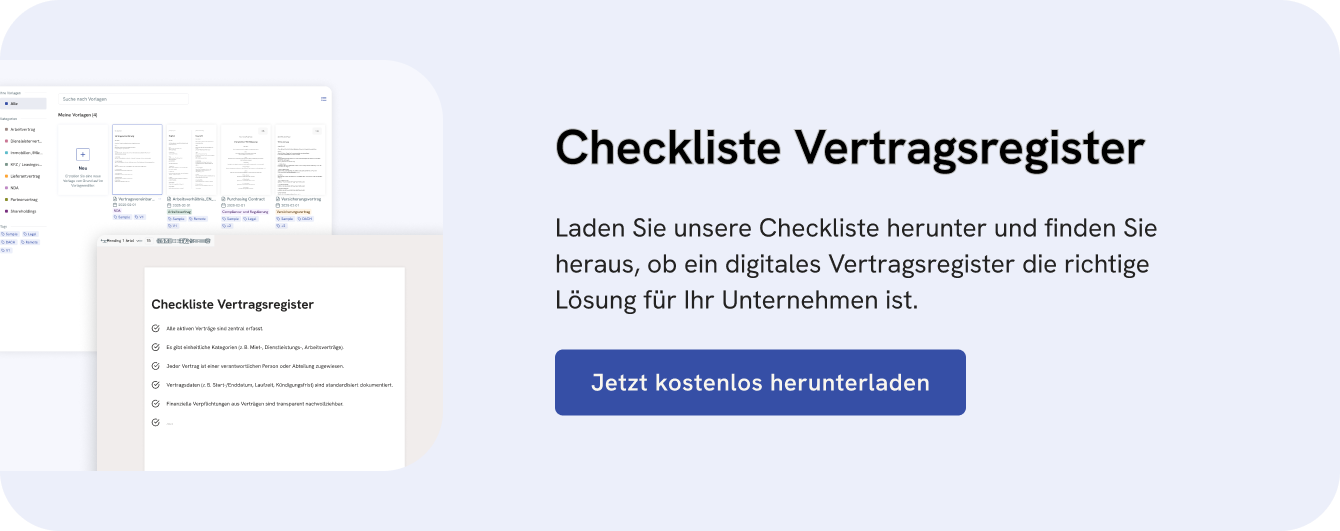
Find out whether a digital contract register is the right solution for your company: