What is a termination agreement?
A termination agreement is a written agreement between the employer and employee that terminates the employment relationship by mutual consent. Unlike a notice of termination, which is issued unilaterally, a termination agreement requires the consent of both parties. This form of termination opens up a wide range of options: in addition to the exact termination date, provisions can also be made regarding severance pay, remaining vacation entitlements, leave of absence or a qualified reference. The termination agreement is a frequently used instrument, particularly in situations in which a termination would be legally uncertain or a quick solution needs to be found.
From a legal standpoint, it is crucial that the agreement be entered into voluntarily and not as a result of pressure or deception. Only then is the contract valid. Furthermore, it must always be concluded in writing. Since a termination agreement can often have significant consequences for the employee—such as a waiting period for unemployment benefits or tax liabilities—a careful review is essential. For employers, on the other hand, it can be a flexible means of terminating employment relationships without having to go through dismissal protection proceedings or lengthy deadlines .
Severance pay in the event of a termination agreement
In many cases, a termination agreement is linked to a severance payment. The payment of a severance payment serves as compensation for the loss of the job and is intended to persuade the employee to sign the agreement. There is no legal entitlement to a severance payment; it is purely a matter of negotiation. Employers often use severance pay to avoid possible dismissal protection claims and to draw a clean line under the employment relationship.
The amount of severance pay depends heavily on the circumstances of the individual case: length of service, salary level and the prospects of success of a possible dismissal protection claim play a significant role. Employees should bear in mind that a severance payment that is too high can also have disadvantages, as it may result in a suspension of unemployment benefits. The following applies to both sides: a transparent agreement on the amount, timing and modalities of payment creates clarity and prevents later disputes.
When is there a severance payment?
In principle, there is no entitlement to a severance payment in connection with a termination agreement. However, it is often agreed because both sides can benefit from it. For the employer, the payment means legal certainty and planning clarity, as they do not have to fear lengthy dismissal protection proceedings. For the employee, the severance payment offers a financial transitional solution until the next employment relationship or the payment of unemployment benefits. Even if the termination agreement is concluded at the employee's request, it is possible to negotiate a severance payment.
How is the severance payment calculated?
The amount of severance pay can be negotiated individually. In practice, however, a rule of thumb has become established: half a month's gross salary per year of service. This calculation is based on the statutory regulation on severance pay in the event of dismissal for operational reasons in accordance with § Section 1a of the Dismissal Protection Act (KSchG). In the special case of dismissal for operational reasons, this stipulates that employees can receive a severance payment of 0.5 months' salary per year of employment, but only if they do not file an action for unfair dismissal.
This provision does not apply directly to termination agreements. Nevertheless, in practice it is often used as a benchmark when employers and employees negotiate the amount of severance pay. Example: If an employee has worked for a company for five years and earns 4,000 euros gross per month, the typical basis for negotiation would be around 10,000 euros. However, the employer and employee can also agree on higher or lower amounts. It is important that the contract clearly states when the severance payment is to be made and whether it is to be understood as gross or net.
What is the maximum severance payment?
There is no statutory upper limit for severance payments. In social compensation plans or in the case of mass redundancies, very high amounts are sometimes paid that exceed several months' salary. The decisive factor for employees is that the severance payment is appropriate in relation to the length of employment and the situation. Anyone expecting a high severance payment should bear in mind that this may be associated with a suspension period or suspension of entitlement in the case of unemployment benefit. To avoid disadvantages, it is advisable to be realistic about the amount and, in case of doubt, to seek tax and social law advice.
Tax aspects
A severance payment counts as taxable income and must therefore be taxed. Social security contributions are generally not payable because it is not a normal salary. To ensure that employees do not slide into a significantly higher tax rate due to the one-off high payment, there is the so-called fifth rule. It is set out in § 34 of the Income Tax Act (EStG) and ensures that the severance payment is treated as if it were spread over five years. This significantly reduces the tax burden.
Important to know: Since 2025, employers no longer automatically take the one-fifth rule into account when making payments. Employees must claim it themselves as part of their income tax return. It is therefore worth seeking tax advice at an early stage to avoid unnecessary disadvantages.
Termination agreement at the request of the employee
It is not always the employer who initiates a termination agreement. Employees can also express the wish to terminate the employment relationship in this way. The reasons for this are often a quick move to a new employer or the desire to avoid long notice periods. A termination agreement enables a flexible and usually uncomplicated separation without the employee having to give notice.
Reasons and advantages
A termination agreement gives employees the opportunity to actively shape the termination of their employment relationship. It offers a flexible alternative to termination and can have many advantages. It is a particularly attractive option if a quick change or clear framework conditions are desired.
- Quick Transition: Employees can terminate their employment much sooner than would be possible with a regular resignation, which is subject to a notice period ( notice period ). This allows them to start a new job without a long wait.
- Individual arrangements: Severance pay, remaining leave arrangements, time off or the issuing of a reference can ideally be arranged flexibly and tailored to personal needs.
- Avoid conflicts: Disputes before the labor court, which often arise after a dismissal, can be ruled out by an amicable solution. This saves time, costs and nerves.
- Co-determination: Employees have a say in the terms of the separation. This conveys a sense of control over the entire process.
Possible risks
Despite its many advantages, a termination agreement is not without its risks. Before signing a termination agreement, employees should carefully consider the consequences it entails. Without legal advice, disadvantages can arise that can hardly be corrected later.
- Loss of protection against dismissal: By signing the contract, employees waive the right to invoke the Protection against Dismissal Act and take action against the termination.
- Blocking period for unemployment benefit: The Federal Employment Agency often classifies a termination agreement as voluntary redundancy. In many cases, this leads to a blocking period of up to twelve weeks.
- Tax burden: A severance payment increases taxable income. Without careful planning, this can lead to a significantly higher tax burden.
- Loss of special protective rights: Employees with special protection against dismissal, such as pregnant women or severely disabled persons, lose their legally guaranteed protection as a result of the termination agreement.
- Possible losses in pension provision: Entitlements to company pension schemes or supplementary pensions can also lapse if they are not checked and contractually secured in good time.
Role of the employer in the termination agreement
The termination agreement also has advantages and disadvantages from the employer's perspective. One of the advantages is that it enables a quick and legally secure termination of the employment relationship without the threat of an action for unfair dismissal. As no notice periods have to be observed, the employment relationship can often end immediately or on an agreed date. Employers also appreciate the discretion, as a termination agreement can be concluded without the involvement of the works council. It therefore offers a practicable solution for companies in a restructuring phase or in the event of conflicts with individual employees.
The termination agreement is not without its disadvantages for employers. In most cases, a severance payment must be made to persuade the employee to sign the agreement. Negotiations can also be time-consuming. There is also the risk that a generously drafted termination agreement may set a precedent and other employees may demand similar arrangements.
Rights and obligations
Employers like to use termination agreements because they enable a quick and uncomplicated termination of the employment relationship. There are no notice periods and lengthy dismissal protection proceedings can be avoided. To ensure that this instrument is not misused, termination agreements are subject to the principle of fair negotiation. This requirement demands that both sides maintain a minimum level of fairness and that employees can make a free and considered decision.
According to current case law of the Federal Labor Court (BAG, judgment of 24.02.2022 - 6 AZR 333/21), a termination agreement is invalid if it is concluded under undue pressure. This is the case, for example, if false facts are presented or if a situation is created that leaves the employee with no real freedom of choice. On the other hand, it remains permissible to present a termination agreement at short notice or to hold out the prospect of a possible dismissal, provided this is realistically justified and does not serve purely as a threat. In the opinion of the court, a lack of reflection time alone does not constitute a breach of the principle of fair negotiation.
For employers, this means that they are obliged to negotiate transparently and without deception. Otherwise, they risk the termination agreement being declared invalid at a later date. Employees, on the other hand, have the right to defend themselves against contracts that have been concluded in unfair or unfair situations.
Avoid typical mistakes
Mistakes often occur when the principle of fair negotiation is not observed. This includes, in particular, when employees are put under pressure or taken by surprise in situations where they cannot make a free decision, such as an unannounced visit to their home. It is equally problematic to exploit language or comprehension barriers, as this can call into question the validity of the contract. It is therefore particularly important to carefully document the discussions in connection with the termination agreement as well as their content and framework conditions. This will help to avoid disputes later on.
Other mistakes include unclear wording or missing regulations, for example regarding the return of company property or compensation for remaining vacation. The lack of written documentation of all ancillary agreements can also lead to conflicts. Employers should therefore ensure that the language is clear.
It is also advisable to seek legal advice in order to avoid typical pitfalls.
notice period and deadlines in the termination agreement
One of the biggest differences between termination and a mutual termination agreement concerns deadlines. While termination is subject to statutory or contractual notice periods, the parties to a mutual termination agreement are free to decide on the termination date. The employment relationship can be terminated entirely according to their individual agreement. This flexibility makes the mutual termination agreement particularly attractive when both sides want to reach a quick resolution.
A termination agreement can not only circumvent regular notice periods, but can also be concluded during a probationary period. While employees and employers can terminate the contract with a shorter notice period during this time anyway, the termination agreement offers additional leeway, as the employment relationship can also be terminated immediately or at any time. This makes it particularly suitable if both parties quickly agree that the collaboration should not be continued.
However, the “ deadlines ” should be taken into account in connection with waiting periods for unemployment benefits. If the employment relationship ends at a time that shortens the regular “ notice period ,” the Employment Agency may impose a “Ruhezeit” or a “Sperrzeit.” It is therefore important to structure the “ deadlines ” in such a way that the employee does not suffer any disadvantages if he or she is entitled to unemployment benefits.
Blocking period at the employment office
A major risk of a termination agreement is the so-called blocking period. If an employee signs a termination agreement, the employment agency often regards this as voluntary redundancy. The legal basis for this can be found in § Section 159 of the German Social Code III (SGB III). As a result, unemployment benefit is blocked for up to twelve weeks. This means that no unemployment benefit is paid for this period. And the money will not be paid subsequently or "added on".
In addition, entitlement may be suspended if the severance payment is deemed “too high.” Unemployment benefits are suspended under Section 158 of SGB III if the employment relationship ends before the expiration of the regular notice period and a severance payment is made. A waiting period under Section 159 of SGB III may apply if there is no good cause for the termination agreement. As a guideline, half a gross monthly salary per year of employment is used as a reference value. If the severance payment is significantly higher than this amount, the Employment Agency may suspend the entitlement to unemployment benefits for a certain period. During this time, no unemployment benefits are paid, as the severance payment is considered compensation. Afterward, the entitlement is reinstated.
When does a blocking period occur?
A waiting period begins if the Employment Agency does not recognize a valid reason for the termination of the employment relationship. Such a reason exists only if termination by the employer would have been unavoidable in any case—for example, if the job would have been eliminated anyway because the company is cutting positions (operational reasons, such as a site closure or mass layoff) or because the employee can no longer perform their duties for health reasons. In such cases, the Employment Agency does not consider the termination agreement to constitute a “voluntary resignation” from the job. However, if no such reason exists, the Employment Agency classifies the termination agreement as unemployment caused by the employee’s own fault. In this case, unemployment benefits are reduced in accordance with Section 159 of SGB III.
How can they be avoided?
To avoid a waiting period, the termination agreement should state that the termination of the employment relationship is due to business reasons and that termination would otherwise have been unavoidable. In addition, the agreed-upon severance payment should not be significantly higher than what is customary according to the statutory rule of thumb of half a month’s gross salary per year of employment. If the severance payment is significantly higher, the Employment Agency may suspend the employee’s entitlement to unemployment benefits. It is also helpful if the agreement expressly provides for compliance with the standard notice period ( notice period ).
If possible, employees should have the contract checked by the employment agency before signing it or seek legal advice in order to avoid financial disadvantages.
Termination agreement in special situations
Termination agreements are not only used in traditional employment relationships. It can also be a sensible alternative to termination in other legal relationships. Especially when notice periods are very long or contractual requirements are difficult to implement, it creates a flexible solution. This allows individual agreements to be made that create clear advantages for both employees and contract partners. Particularly in tenancy or training relationships or in special circumstances such as illness or parental leave, the termination agreement enables an amicable and legally secure termination that is associated with fewer conflicts than a traditional termination.
Tenancy agreement: Cancellation agreement as special termination
Lease agreements are generally open-ended and subject to strict notice periods. If a tenant or landlord nevertheless wishes to terminate the agreement early, a termination agreement can provide a solution. In this case, both parties agree to end the lease at a specific date. This is particularly useful when a tenant wants to move out of an apartment early without having to find a replacement tenant. For landlords, the agreement offers the opportunity to make the property available more quickly than the German Tenancy Act ( notice period ) permits.
Training: Special features and legal information
Apprenticeship contracts may also be terminated by a termination agreement. However, special provisions apply in this case. During the probationary period, which, according to Section 20 of the Vocational Training Act (BBiG) must last at least one month and no more than four months, termination is possible at any time. In addition, the notice period ( notice period ) during this phase is normally two weeks.
A termination agreement offers additional flexibility in this situation: It can end the apprenticeship immediately or on a mutually agreed-upon date without having to comply with deadlines . This helps avoid unnecessary conflicts and allows for clear agreements regarding the recognition of apprenticeship periods already completed or the issuance of certificates. Especially when trainees realize that the chosen apprenticeship isn’t a good fit, or when the company recognizes that other qualifications would be more suitable, the termination agreement is a fair and transparent solution.
For parental leave or illness
A termination agreement can also be concluded during parental leave or in the event of prolonged illness. A proper legal examination is particularly important in such cases, as there are special protective rights. If the employment relationship is terminated due to health restrictions, this can have an impact on pension or insurance claims, for example. Employees should therefore find out about the possible consequences at an early stage before signing a contract.
Comparison: Cancellation agreement or termination?
Whether a termination agreement or dismissal makes more sense depends on the objectives of the parties involved. Dismissal offers employees the protection of the Dismissal Protection Act and preserves special rights, such as in the case of pregnancy or severe disability. It also forces the employer to comply with statutory or contractual notice periods.
The termination agreement, on the other hand, enables a flexible and often quicker solution. Both parties can freely determine the date of termination and make additional agreements. For employees, the termination agreement is particularly interesting if a quick change to a new employer is imminent. Employers use it to create legal certainty and avoid potential lawsuits.
Formal requirements and design
A termination agreement is only effective if it is concluded in writing. Verbal agreements or electronic signatures are not sufficient. It is also important that both parties sign the agreement voluntarily and have sufficient time to review it. Otherwise, the contract can be contested at a later date.
As the termination agreement has far-reaching consequences, all relevant points should be regulated in detail. These include the termination date, a possible severance payment, provisions on leave of absence, compensation for remaining vacation and overtime and the issue of a qualified reference. Agreements on the return of company property or confidentiality can also be part of the contract. The more detailed the agreement is, the lower the risk of later disputes.
Written form requirement
The written form is required by law. According to § 623 BGB the termination agreement must be on paper and signed by both parties in person. Fax, e-mail or digital signatures are not sufficient. The only exception is if several identical copies are created and each party receives a copy with their own signature. If this form is not observed, the contract is invalid and the employment relationship continues.
Typical clauses
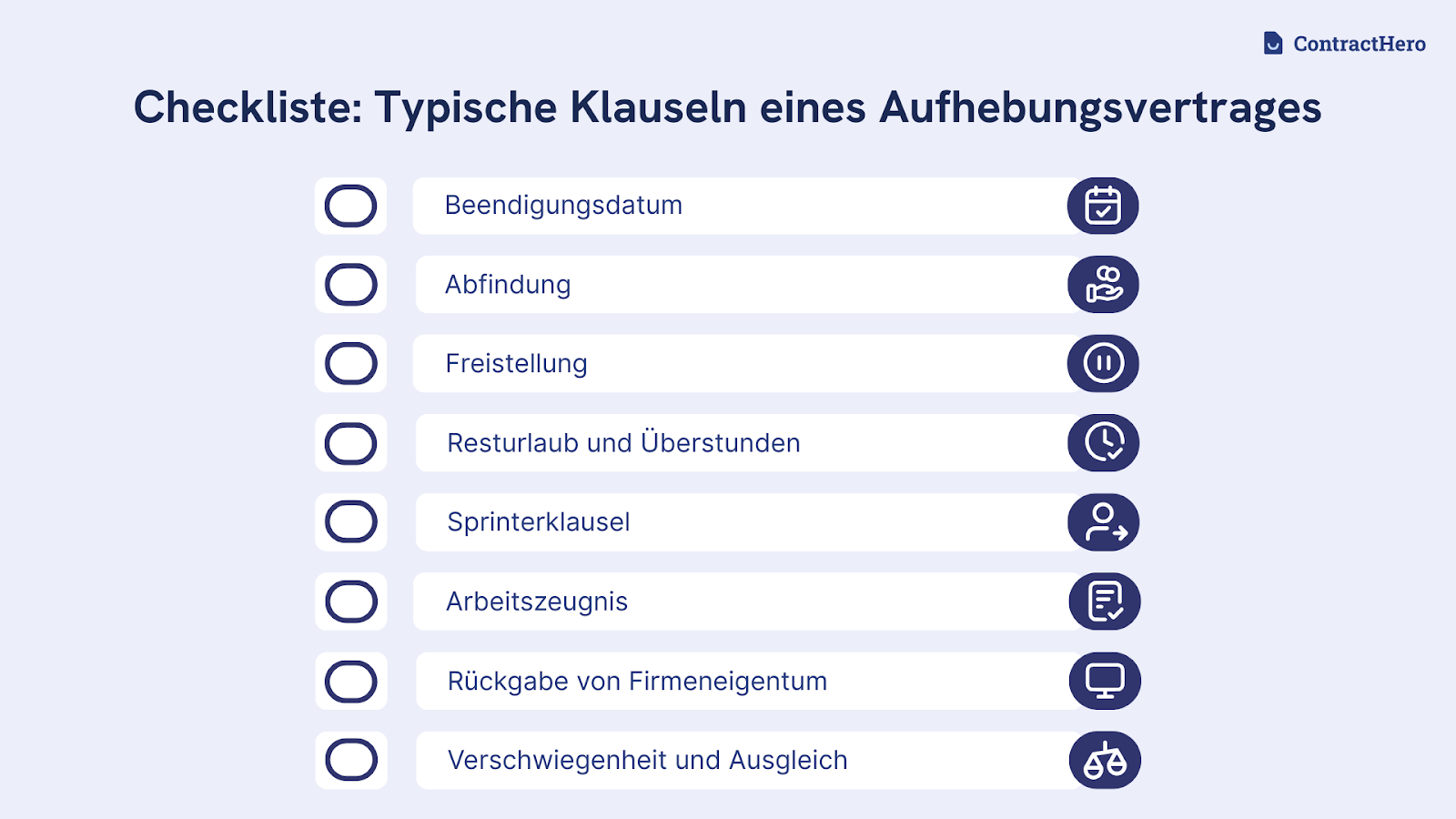
To ensure that a termination agreement is legally secure and clearly understandable, all important points should be explicitly regulated. Incomplete or unclear wording harbors the risk of disputes later on. The following points are particularly common:
- Termination date: The exact end date of the employment relationship is specified in order to provide clarity for both parties.
- Severance payment: The amount, timing and method of payment are determined precisely. Employers often follow the rule of thumb of half a month's salary per year of employment.
- Release from work: It is determined whether the employee will continue to work until the end of the contract or whether he/she will be released from work on a revocable or irrevocable basis.
- Remaining vacation and overtime: Agreements determine whether outstanding vacation days and overtime are credited or paid out.
- Sprinter clause: The employee can leave earlier if they find a new job. This is usually linked to an additional financial incentive.
- Employment reference: The issue of a qualified and favorable reference is guaranteed, often with a specific evaluation grade.
- Return of company property: Laptop, company car, cell phone and other work equipment must be returned on time.
- Confidentiality and compensation: Confidentiality agreements and a comprehensive compensation clause ensure that all mutual claims are settled upon signing.
Conclusion: The most important things at a glance
A termination agreement can be the quickest and cleanest way to end an employment relationship - provided that both parties act voluntarily, fairly and with an eye on the consequences. Because the agreement offers a great deal of flexibility, the termination date, severance pay, leave of absence, remaining leave and references can be precisely regulated. However, it is precisely this freedom that requires care: the written form (Section 623 BGB) is mandatory, the amount of severance pay is a matter for negotiation (the often used 0.5 rule is only a guideline), and taxes (fifth rule) and benefit claims with the Federal Employment Agency (blocking period according to Section 159 SGB III or suspension according to Section 158 SGB III) should be checked in advance.
For employees, this means: don’t sign anything hastily, take time to think it over, document your reasons, and have your situation reviewed in terms of labor, social security, and tax law. For employers, the key is to ensure fair negotiations, choose clear wording, and document discussions in a transparent manner—this ensures the contract remains robust and immune to legal challenges. Those who follow these principles can reap the benefits of a termination agreement without taking on avoidable risks. ContractHero helps you keep track of contracts, deadlines, deadlines , and clauses in one place —from drafting and approval all the way to audit-proof filing. This turns a sensitive step into a well-managed process.