


Projects rarely fail because the product doesn’t work. More often than not, it’s because the client and contractor have different understandings of the scope of work, deadlines, and responsibilities. At the latest when changes are pending, additional claims arise, or milestones are missed, it becomes clear whether the contract was used as an active management tool or is merely a signed document sitting in a file folder. In this article, you’ll learn how structured contract management keeps projects on track, what roles project management, the legal department, and the finance department play in this process, and which digital solutions deliver the greatest benefits.
What does contract management mean in project management?
Contract management in project management involves systematically managing all project-related contracts throughout their entire lifecycle. This includes preparation, negotiation, execution, ongoing administration, and acceptance of services. In some cases, structured data collection is recommended even before these phases to identify goals, requirements, and risks early on. It is precisely this approach that makes contract management so important in a project context: it ensures that contractual terms are not isolated from the project but are closely aligned with project goals, resources, budget, and milestones.
At its core, contract management in project management ensures that contractual terms and changes remain traceable at all times. This is crucial because projects are constantly subject to adjustments and coordination. If changes are not properly documented and reflected in the contract, financial risks, delays, or conflicts between the parties can quickly arise. Contract management therefore creates transparency, supports the monitoring of contract fulfillment, and forms an important foundation for reliable project management.
Benefits of Contract Management in Project Management
The key benefits of contract management in project management include increased transparency, better control, and reduced risks. Contracts provide clarity within the project regarding what has been agreed upon and what the parties involved must adhere to. Structured contract management ensures that these agreements are not lost sight of as the project progresses and that necessary adjustments are identified in a timely manner. This makes implementation easier to manage and reduces the coordination effort required on a day-to-day basis.
Another advantage is the early detection of problems. If changes, risks, or potential additional claims are properly documented and tracked, financial and operational consequences can be managed much more effectively. Working in a structured manner reduces misunderstandings, prevents gaps in contract fulfillment, and creates a solid foundation for decision-making. At the same time, contract management improves collaboration between departments, as all stakeholders have access to the same contractual information. This transforms the contract from a mere formality into an active tool for steering project success.
Risk reduction
Projects often come under pressure not because of a lack of planning, but because of unclear contractual terms. Contracts define services, deadlines, responsibilities, and potential consequences in the event of deviations. If these details are not clearly documented and continuously monitored, legal, operational, or financial problems can quickly arise. The situation becomes particularly critical when contract changes are not documented in a traceable manner or when important factors such as prices, scope of services, or deadlines are not updated.
Structured contract management helps identify and mitigate such risks at an early stage. It helps identify performance issues, the need for changes, and potential additional claims in a timely manner. At the same time, it creates a robust documentation foundation that is just as important in day-to-day project operations as it is during audits or subsequent reviews. In this way, contract management not only ensures greater security during the project but also provides a better basis for decision-making in the event of unexpected developments.
Improved budget control
Reliable budget control in project management is only possible if the contractual terms are clear and up to date. Contracts not only specify prices, but often also payment terms, scope of work, additional services, and potential adjustments. If this information is not properly documented and continuously updated when changes occur, financial uncertainties or unexpected additional costs can quickly arise.
Structured contract management improves budget control because it identifies financial obligations early on and is closely linked to change and additional claim management. This enables project managers to better understand which costs are contractually covered, where variances arise, and how adjustments affect the overall budget. This not only creates greater transparency for project management but also provides a solid foundation for financial and management decisions.
Process Optimization
A clearly defined contract management process improves workflows throughout the entire project. Contract management encompasses the preparation, negotiation, execution, and ongoing management of contracts. When these steps are managed in a structured manner, coordination between project management, functional departments, and external partners can be organized much more efficiently.
This is particularly important in project management because contracts are closely linked to milestones and risks. A well-defined process ensures that relevant information is readily available, changes are documented in a traceable manner, and problems do not surface only at the end. At the same time, it improves collaboration among stakeholders and establishes a consistent basis for decision-making. In this way, contract management becomes an integral part of efficient project management rather than a purely administrative task.
Types of Project Contracts
Depending on the project’s objectives, scope of work, and risk allocation, different types of project contracts are used. A project contract specifies the services to be provided, the obligations assumed by the contracting parties, and the conditions governing changes, acceptance, and payment. This contractual framework is particularly crucial in project management because it establishes the parameters for the budget, resources, deadlines, and collaboration.
Possible project contracts include fixed-price contracts, option contracts, and other types of contracts, which vary depending on the project structure and service model. In addition, there are various collaboration arrangements, such as those involving subcontractors or external project partners. The appropriate type of contract depends heavily on how clearly the scope of work can be defined and how flexibly the project must adapt to changes.
For companies, therefore, it is not only important to choose the right type of contract, but also to manage it on an ongoing basis. Only through structured contract management can project contracts become reliable in day-to-day operations and effective for project management.
Contracts for Work vs. Service Contracts
For project contracts, the distinction between contracts for work and contracts for servicesis particularly important. In a contract for work and services, a specific result is owed—that is, a clearly defined outcome or work product. This is governed by Section 631 of the German Civil Code (BGB). In a contract for services under Section 611 BGB, however, the performance of services is owed, but not a specific result. It is precisely this distinction that is central to project management, as it gives rise to different requirements regarding acceptance, remuneration, and
performance evaluation.
Contracts for work and services are particularly suitable when a specific result is owed, such as the development of a software function, the preparation of an expert opinion, or a clearly defined implementation package. Service contracts, on the other hand, are better suited to ongoing services such as consulting, coaching, or project-related support, where the focus is not on a specific outcome but on the activity itself.
In project management, this means that if the desired outcome can be clearly defined, a contract for work and services may be appropriate. If, on the other hand, the focus is on ongoing work or support, a service contract is often a better fit. The choice of contract type therefore directly influences how services are monitored, documented, and contractually secured.
Agile Project Contracts
Agile project contracts are particularly relevant in situations where requirements, scope of work, or priorities are not fully defined from the outset. Unlike rigid contract models, they must allow room for changes without losing control of the project. This is precisely where the close connection between contract management, change management, and change order management becomes apparent: changes can only be managed effectively if they are clearly documented, contractually tracked, and evaluated for their impact on budget, scope, and deadlines.
In practice, this means that even with more flexible project contracts, clear rules are needed for adjustments, responsibilities, and documentation. This is the only way to ensure that rights and obligations remain transparent and to avoid future conflicts. Contract management thus provides structure, transparency, and a solid foundation for decision-making, even in agile projects.
IT-specific contract types
An IT project contract generally needs to provide for greater flexibility and precision than many traditional project contracts. In IT projects in particular, requirements, scopes of work, or technical conditions often change as the project progresses. That is why it is especially important to clearly define contractual provisions regarding, for example, services or changes, and to keep them up to date on an ongoing basis.
In addition, IT projects are often carried out with multiple stakeholders, such as external service providers, subcontractors, or project partners. This makes the contractual situation more complex and requires careful coordination. A structured approach to the IT project contract creates transparency and helps limit risks, additional claims, and misunderstandings at an early stage. In this way, the contract becomes not only a legal safeguard but also an active tool for managing complex IT projects.
Responsibilities of IT Contract Management
Core IT contract management tasks go far beyond simply filing contracts. At its heart, the process involves actively managing contracts throughout the entire project lifecycle: from preparation and negotiation through to contract execution and final acceptance. This is particularly crucial in the IT sector, where projects are often characterized by frequent adjustments, multiple stakeholders, and complex service relationships.
Effective IT contract management ensures that services, deadlines, responsibilities, and financial implications remain transparent at all times. This includes properly documenting contract changes, monitoring contract performance, and identifying potential risks or additional claims at an early stage. A close link to change, risk, and document management is particularly important. Only when contractual adjustments are systematically tracked can conflicts, budget variances, and delays be effectively minimized.
In this way, IT contract management establishes a solid foundation for managing complex IT projects and ensures that contracts can be used as an active management tool in day-to-day operations.
The Use of AI in Contract Management
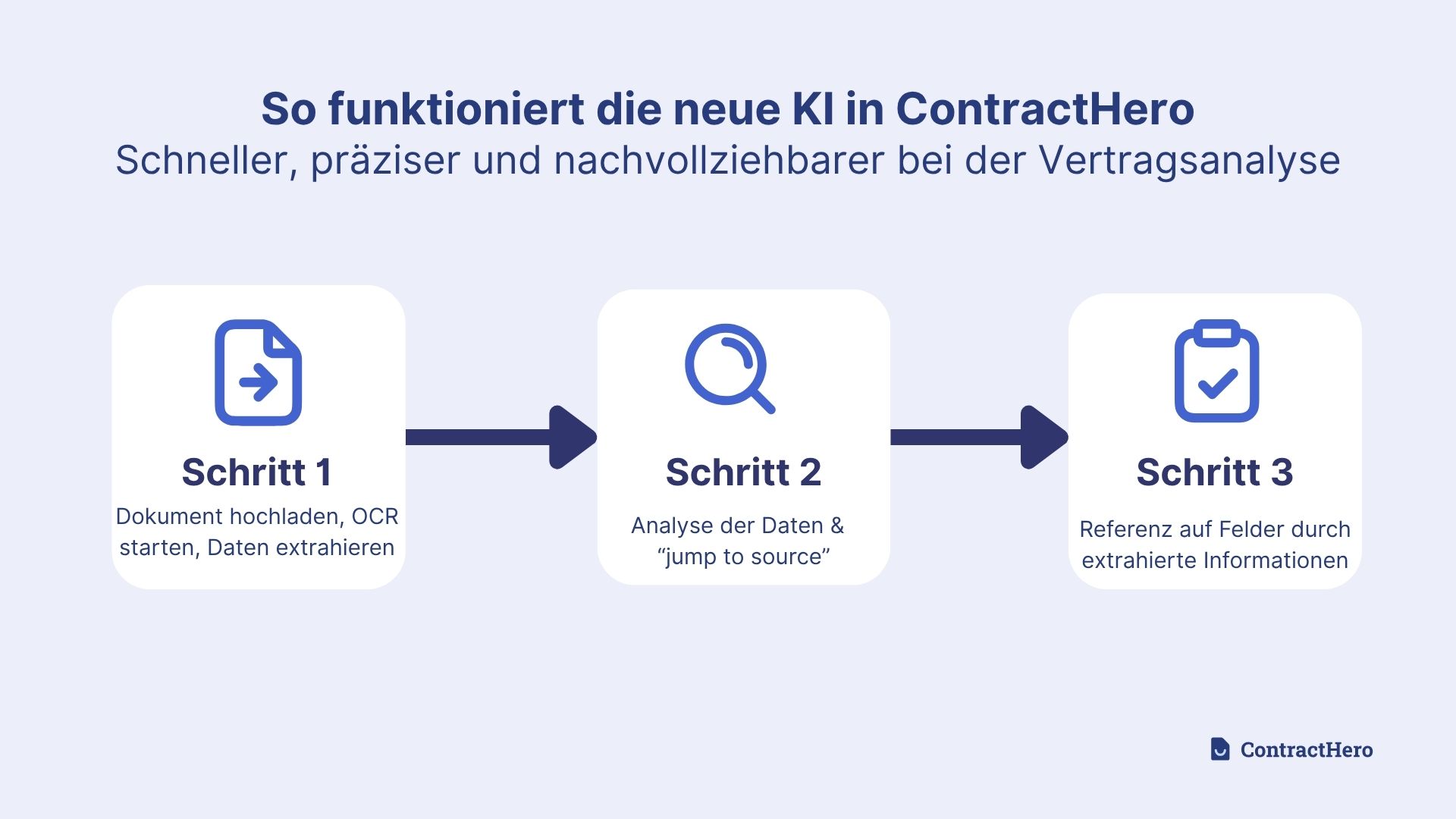
In project management, the effectiveness of contract management depends heavily on information being complete, up-to-date, and readily available. This is precisely where AI-powered contract management can deliver tangible value. AI helps analyze large volumes of contracts more quickly, organize relevant content in a structured manner, and systematically capture key contract data. This includes, for example, deadlines, scope of services, responsibilities, prices, and renewal clauses. At the same time, AI improves the searchability of contracts because information is not merely stored within the document but can be specifically located and utilized for further management purposes.
This can significantly reduce the amount of manual work, especially in dynamic projects involving many stakeholders. Instead of laboriously reviewing contracts and amendments page by page, key information can be identified more quickly and made available for project management. AI does not replace legal or technical assessments, but it does help to significantly improve transparency, responsiveness, and the reliable use of contract data in day-to-day project work.
Tools and Software for IT Contract Management
In complex projects, professional IT contract management can hardly be managed efficiently without digital support. Research shows that contract management in a project environment must fulfill many tasks simultaneously: preparing contracts, documenting changes, monitoring deadlines and contract performance, and identifying risks and potential additional claims at an early stage. This is precisely where IT contract management software provides the necessary structure.
These tools help make contracts centrally accessible, ensure that all parties involved have consistent access to information, and document contractual changes in a traceable manner. This not only simplifies contract management from an administrative standpoint but also enhances its strategic value. After all, it is only with a structured digital foundation that transparency, control, and efficiency in day-to-day project work can be sustainably improved.
Conclusion
Contract management in project management is far more than just a minor administrative task. It lays the groundwork for actively managing contracts, identifying risks early on, better controlling budgets, and efficiently organizing processes in day-to-day project work. This is particularly crucial in the IT sector and in dynamic project environments, where changes, dependencies, and various stakeholders interact in a highly interdependent manner.
Managing contracts in a structured manner creates greater transparency regarding services, deadlines, responsibilities, and financial implications. At the same time, the contract becomes not only a legal safeguard but also a genuine management tool for the entire project. Digital tools and the strategic use of AI can further enhance this effect by making information available more quickly and reducing manual effort.
ContractHero allows you to centrally consolidate contracts, deadlines, responsibilities, and relevant contract data, enabling project teams to maintain a clear overview even in complex and dynamic environments and to use contract management as an active component of project management.
.svg)


.avif)




_BestSupport_QualityOfSupport%20(5).png)



.avif)