

.jpg)
As of January 17, 2025, the DORA Regulation will be mandatory for financial firms in the EU. It introduces specific requirements that directly impact existing processes: hundreds of service provider contracts must be reviewed for DORA compliance, audit rights and reporting obligations must be enshrined in contracts, and the DORA information register requires structured, reliable data. Anyone attempting to manage this with manual processes will quickly reach their limits. In this article, you’ll learn what DORA specifically requires, who it affects, and how structured contract management helps ensure regulatory requirements are implemented efficiently and comprehensively.
Key Points of the DORA Regulation at a Glance
The DORA Regulation has been mandatory for financial firms in the EU since January 17, 2025. It sets out how digital risks must be managed, IT incidents reported, and dependencies on third-party ICT service providers (companies that provide or operate IT systems, software, or digital infrastructure for financial firms) made transparent.
A key issue here is the management of external IT service providers. Companies must fully document all ICT service contracts, analyze them in a structured manner, and make them available to meet regulatory requirements. In practice, this is often where the greatest implementation effort arises.
What is the DORA Regulation?
The DORA Regulation is an EU-wide legal framework for regulating digital risks in the financial sector and is directly applicable in all member states.
The goal is to establish a uniform level of digital operational resilience. Financial institutions should remain capable of operating even if their IT systems fail or come under attack.
At its core, DORA sets out binding requirements for managing IT risks. Companies must continuously monitor risks, report security incidents within clear timeframes, and disclose their dependencies on third-party ICT service providers (companies that provide or operate IT systems, software, or digital infrastructure for financial firms).
A key difference from previous regulations lies in their direct applicability. DORA applies throughout Europe without requiring national implementation. As a result, the requirements are clearly defined, while at the same time the pressure on companies to implement them in a structured manner is increasing.
Why was DORA introduced?
Increasing digitalization has made the financial sector more efficient. At the same time, it has created new dependencies.
A single IT outage today can disrupt cash flows, halt business processes, or prevent access to customer data.
In addition, many of these systems are no longer operated entirely in-house. Cloud providers, software service providers, and external platforms are now an integral part of the infrastructure.
Until now, regulatory requirements have varied across the EU. This has led to inconsistencies and security gaps.
The DORA Regulation closes this gap. It requires companies to systematically identify, assess, and continuously manage digital risks.
Who is affected by the DORA Regulation?
The DORA Regulation applies to virtually all regulated financial firms. These include banks, insurance companies, payment service providers, and investment firms.
However, it’s important to take a closer look.
The focus is also on third-party ICT service providers. These are providers on whom financial firms rely for key aspects of their business operations, such as the operation of core banking systems, payment infrastructures, cloud platforms, or central data processing systems. Typical examples include:
- Cloud provider
- IT outsourcing provider
- Software and SaaS providers
- Data centers
These service providers are particularly critical when an outage has a direct impact on the functioning of financial services or when many regulated companies rely on the same provider at the same time.
In such cases, direct European oversight may be exercised, for example by the European supervisory authorities. This means that, for the first time, major IT service providers themselves are also coming under greater regulatory scrutiny.
For more detailed information on the scope of the legislation and its interfaces with NIS2—which expands cybersecurity requirements and reporting obligations to include additional critical and important facilities across all sectors—please find an in-depth overview here: OpenKRITIS: Digital Operational Resilience Act
What changes will the DORA Regulation bring?
DORA significantly tightens existing requirements while also expanding their scope.
IT risks are no longer viewed in isolation. They are becoming an integral part of corporate governance.
At the same time, responsibility is shifting. Decisions regarding IT security no longer rest solely with the IT department, but at the management level.
That changes the perspective. A technical issue becomes a strategic challenge.
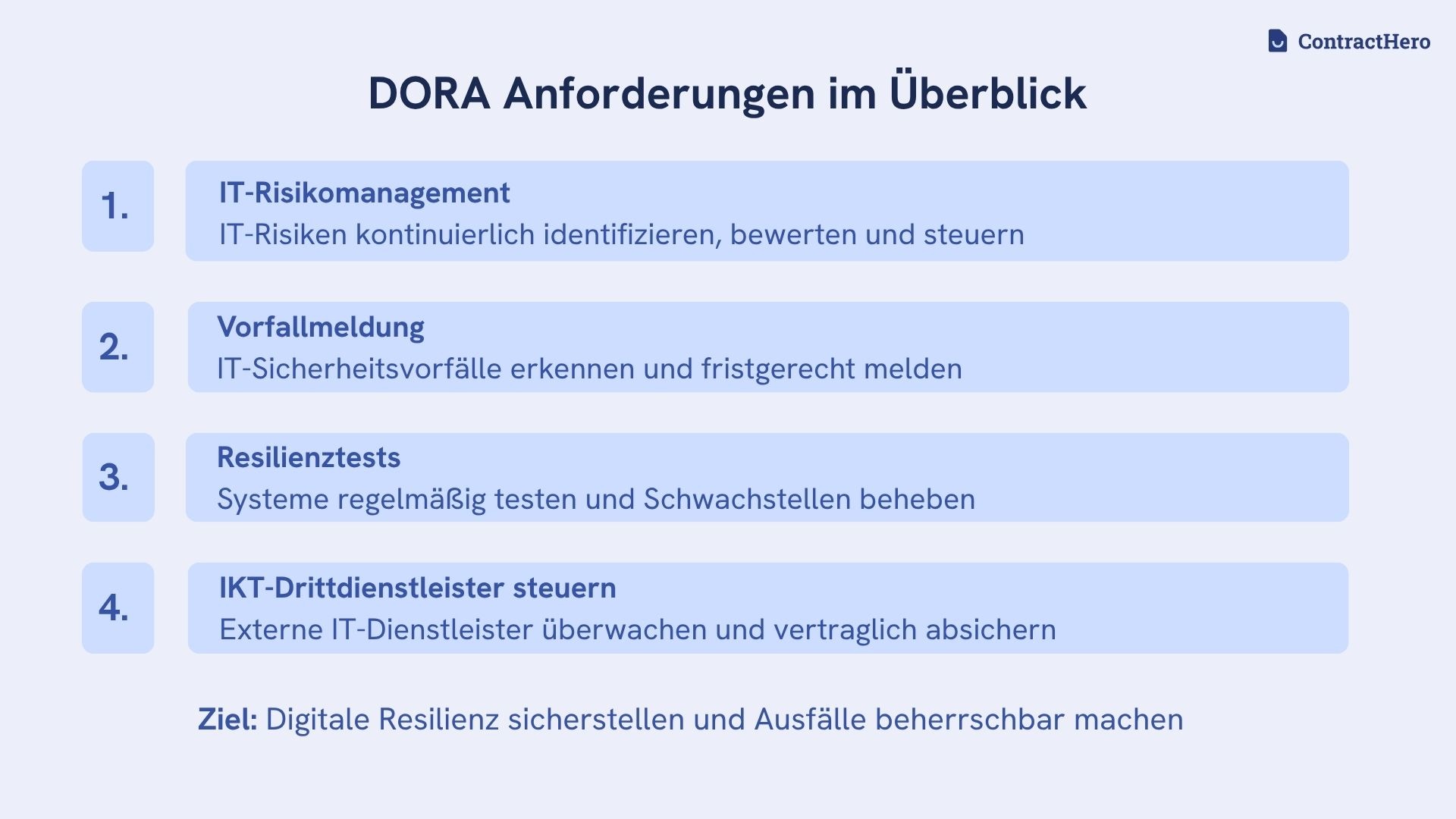
DORA Requirements: What Companies Need to Do Specifically
The requirements of the DORA Regulation apply to several areas at once. They pertain to organization, processes, and technology.
ICT Risk Management
Companies must establish a structured framework for managing IT risks. Risks should not be viewed in isolation; they must be continuously monitored and managed.
This includes clear lines of responsibility, defined security measures, and processes for backup and recovery.
The most significant change is the integration of IT risk management at the management level. IT risks are no longer purely a technical matter; they have become an integral part of corporate governance.
Reporting of ICT Incidents
Serious IT security incidents must be reported within clearly defined timeframes.
In practice, this means:
- Initial report is typically filed within 24 hours of the incident coming to light
- Interim reports with further details
- Final report following a comprehensive analysis
This requires that companies be able to reliably identify incidents, classify them correctly, and document them in a structured manner.
In many organizations, it is precisely this implementation that fails due to a lack of transparency and unclear processes. Information is scattered, and responsibilities are not clearly defined.
DORA requires clearly defined procedures, clear lines of responsibility, and consistent documentation of incidents. Without these fundamentals, timely and complete reporting quickly becomes a challenge.
Digital Resilience Tests
Companies must regularly assess whether their systems are resilient. This includes penetration tests and simulation-based scenarios that enable vulnerabilities to be identified early on and addressed in a targeted manner, for example by simulating cyberattacks or the failure of critical systems such as payment or data infrastructures.
What matters here is not just conducting the tests, but providing verifiable evidence of digital resilience. Companies must be able to demonstrate how resilient their systems are to disruptions and attacks. This also includes a structured approach to handling test results. Vulnerabilities must be documented, assessed, and translated into concrete measures. At the same time, it must be ensured that the results are incorporated into the further development of security and emergency response processes.
Management of Third-Party ICT Service Providers
A key component of the DORA Regulation is the management of external IT service providers.
Many companies today rely heavily on external providers. This is precisely where risks arise that are often not adequately managed.
DORA therefore requires a complete registry of all ICT service contracts.
This register must not only be complete, but also structured in such a way that information on service providers, services, risks, and contractual obligations can be accessed at any time. In addition, this data must be available in a format that allows it to be processed for regulatory reporting purposes.
In reality, this reveals a clear weakness. Contracts are often stored in a decentralized manner, information is difficult to access, and dependencies are not transparent.
Therefore, simply documenting contracts is not sufficient for DORA-compliant implementation. It is essential that all relevant information be recorded in a structured manner, made centrally accessible, and systematically analyzed. Only in this way can a robust foundation be established for managing third-party ICT service providers and meeting regulatory requirements.
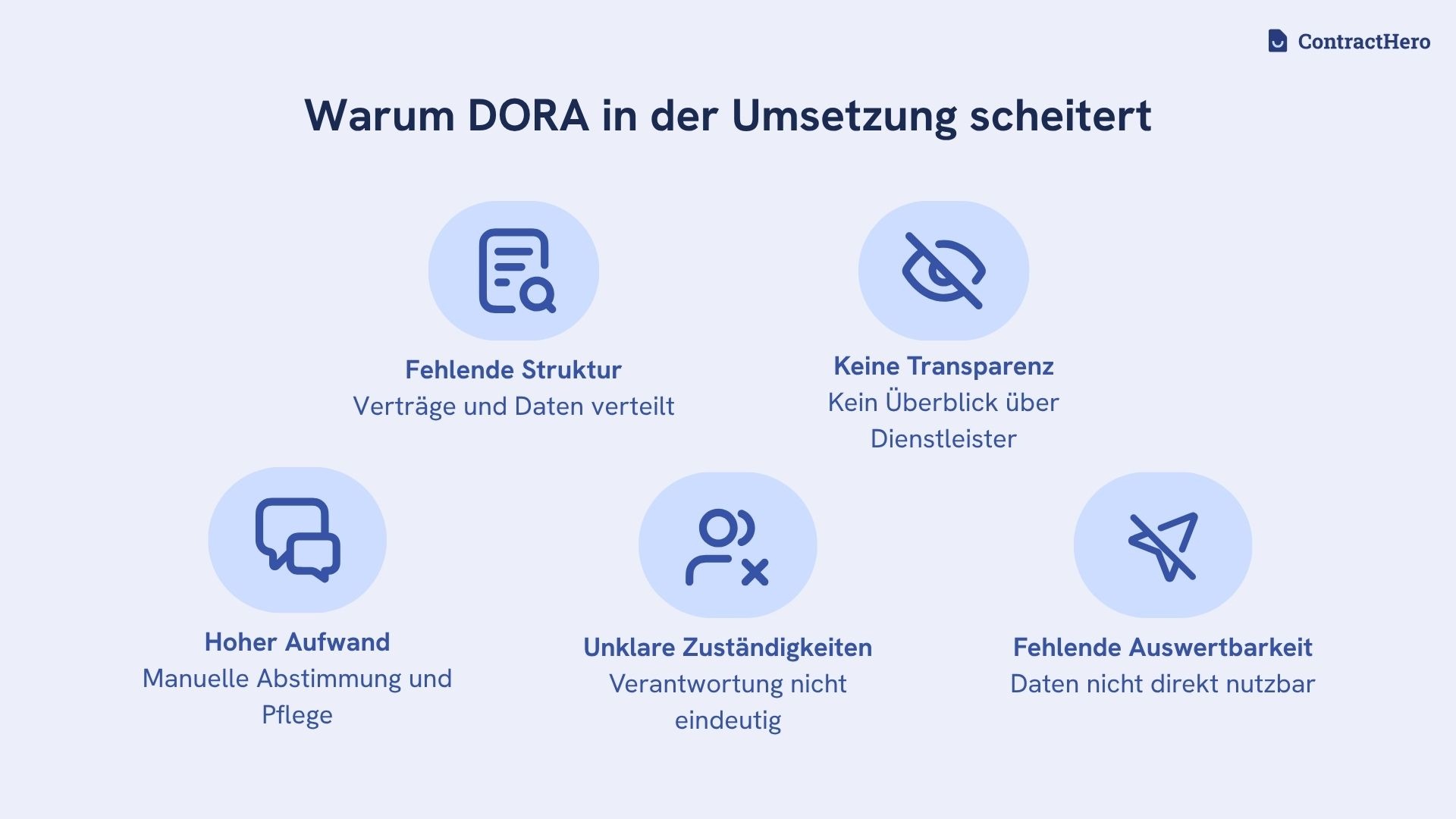
DORA Implementation: Where Companies Are Currently Falling Short
The biggest challenge rarely lies in the technology. In most cases, the necessary solutions already exist.
The real challenge lies in the implementation.
Many companies lack a consolidated overview of their IT service providers and the associated obligations. Information is scattered across various systems, departments, and documents. As a result, there is no reliable basis for management and reporting.
In addition, while regulatory requirements are formally in place, in practice they are not consistently documented or kept up to date. Responsibilities are not always clearly defined, and dependencies on individual service providers remain unclear in some cases.
This leads to operational problems, especially as the IT landscape becomes more complex. Coordination between departments increases, manual maintenance of lists ties up resources, and it becomes more difficult to provide information to regulatory authorities.
Implementing the DORA requirements is therefore less of a technical issue and more a matter of structure, transparency, and clear processes.
What role does contract management play at DORA?
DORA sets out clear requirements for the handling of contracts in the context of ICT service providers. Security requirements, reporting obligations, and audit rights must be explicitly stipulated in contracts.
This information must be accessible at all times to ensure compliance with regulatory requirements.
Structured contract management lays the groundwork for this. Contract details are centralized, relevant information is immediately available, and can be analyzed without manual effort. It is crucial that contract data be recorded consistently using defined fields—such as those related to service providers, contractual relationships, critical or important business functions, or risk classifications—as required by the DORA Information Register.
Solutions like ContractHero help create this transparency and ensure that contract information is consistently tracked across all service providers.
This creates a solid foundation for regulatory requirements, particularly in connection with the DORA information register.
DORA Information Registry: Why Structured Contract Data Is Critical
A key component of the DORA implementation is the so-called Register of Information (RoI). It covers all ICT service providers and contractual relationships and must be submitted to supervisory authorities in a standardized format with clearly defined data fields. In practice, this is done in the form of structured CSV data.
What matters here is not only the completeness of the data, but above all its consistent structure. Only in this way can the information be efficiently processed and converted into the required formats.
In practice, the process follows a clear sequence: contract data is recorded in a structured manner, standardized according to defined fields, and then exported for regulatory reporting.
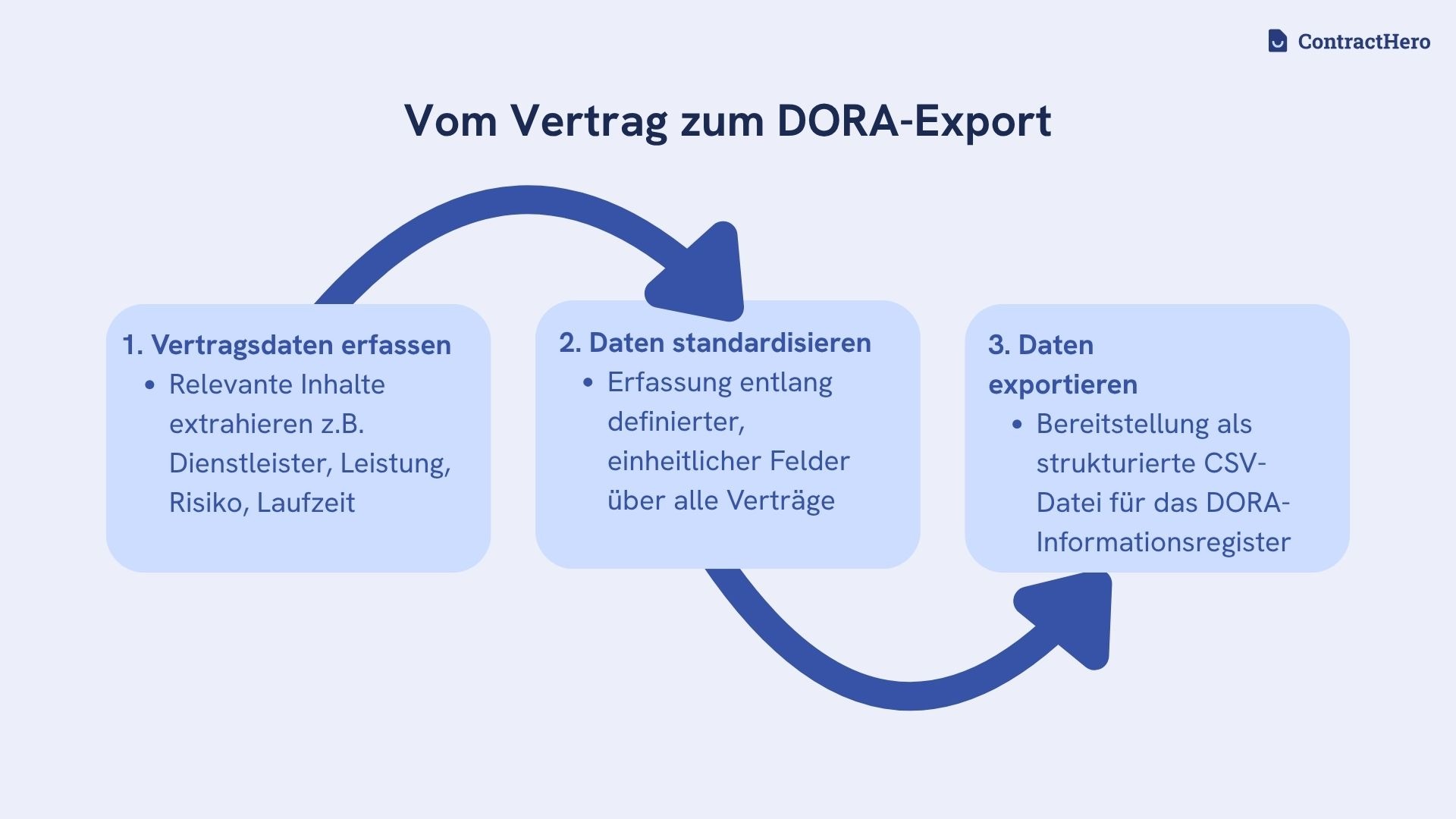
This is precisely where structured solutions add value. With ContractHero, contract data can be captured in a targeted manner using defined fields and consolidated into standardized list views. These can be filtered and exported as structured CSV files. This largely eliminates the need to manually compile data for regulatory filings.
Conclusion: Implement DORA in a structured way and gain control
The DORA Regulation significantly raises the bar for transparency, traceability, and governance. When working with IT service providers in particular, it quickly becomes clear just how complex implementation can be without clear structures.
What matters most is not so much the technology as the way the underlying information is organized. If contracts, obligations, and dependencies are not consistently tracked, you will quickly run into operational limitations during implementation.
Structured contract management provides the necessary foundation here.
ContractHero helps companies centralize their contract management, make relevant content quickly accessible, and systematically address regulatory requirements.
In this way, DORA becomes not just a regulatory requirement, but a tool for increasing transparency and improving the long-term management of processes.
.svg)






_BestSupport_QualityOfSupport%20(5).png)





.avif)