


Searching for contracts in emails, manually tracking deadlines in Excel, coordinating approvals via conference calls: this is still the norm in many companies. The consequences are well known: deadlines are missed, responsibilities are unclear, and cross-departmental collaboration breaks down due to a lack of transparency. Yet the digital transformation of contract management is about more than just storing documents digitally. It’s about mapping out processes in a structured way and making them manageable. In this article, you’ll learn what digital contract management actually means, why many companies fail in its implementation, and how you can successfully drive the digitization of your contract processes with a structured approach.
What does digital contract management mean?
Digital contract management encompasses the structured and software-supported administration and control of contracts throughout their entire lifecycle. This includes structured contract creation based on standardized templates, clearly defined review and approval processes, electronic signatures, and audit-proof archiving.
Unlike purely digital document management, contracts are not only stored but also actively managed. Key components include:
- a uniform filing system for all contract documents
- Systematic monitoring of deadlines and control of contractual obligations
- Clearly defined responsibilities throughout the contract processes
- the structured evaluation of relevant contract data
Professional contract management goes beyond simple file organization. Digital contract management creates transparency regarding terms, risks, and obligations and forms a robust basis for compliance, controlling, and company-wide management processes. This transforms simple document management into a structured and consistent contract management process.
Difference from traditional contract processes
The difference between traditional processes and a digitally supported contract management process lies primarily in the organization of the individual steps. In traditional structures, coordination often takes place without uniformly defined processes and is heavily dependent on individual coordination. Documents are forwarded by email, approvals are not documented uniformly, and signatures are often still made outside of a structured system.
A digital contract management process, on the other hand, enables systematic mapping of the entire contract lifecycle. Responsibilities are clearly defined, processes are structured in a binding manner, and electronic signatures can also be integrated into the process. Changes are documented centrally so that decisions remain traceable.
The key difference therefore lies in consistency. While traditional processes are organized in a fragmented manner, a digitally supported contract management process creates consistent and structured process logic.
.png)
Why is digitization failing in Germany?
In many companies in Germany, digitization is progressing more slowly than is technically possible. The reasons for this often lie less in a lack of technology than in organizational and structural conditions. Digital initiatives are not consistently prioritized, responsibilities are not clearly defined, and projects remain limited to individual areas.
In everyday business life, this lack of prioritization means that processes continue to be organized in a decentralized manner and digital measures are not integrated into existing workflows in a uniform and systematic way. Instead of clearly defined process structures, isolated solutions emerge that do not have a consistent effect.
Regulatory requirements and data protection regulations further increase the complexity of decisions, especially for cloud-based applications. At the same time, many organizations lack human resources and a comprehensive digital strategy.
As a result, digitization in Germany often falls short of its potential. This raises the question in a corporate context of who is responsible for the binding and uniform implementation of digital initiatives.
Who is responsible for digitization in Germany?
Responsibility for digitization is often seen as lying at the state level. Politicians and administrators create regulatory frameworks, invest in infrastructure, and define legal standards. These factors influence the opportunities for digital development in Germany.
However, when it comes to concrete implementation in companies, the responsibility for digitalization lies internally. A viable digitalization strategy is created through clear prioritization and binding decisions within the organization. Management defines objectives and provides resources. Finance teams evaluate economic impacts. Legal teams ensure that processes are designed to be legally compliant and audit-proof.
Only through the coordinated interaction of these functions can a resilient structure for digital processes be created. This makes it clear that digitalization and responsibility are inextricably linked and require clearly defined responsibilities and binding governance.
Efficiency gains through digital contract management
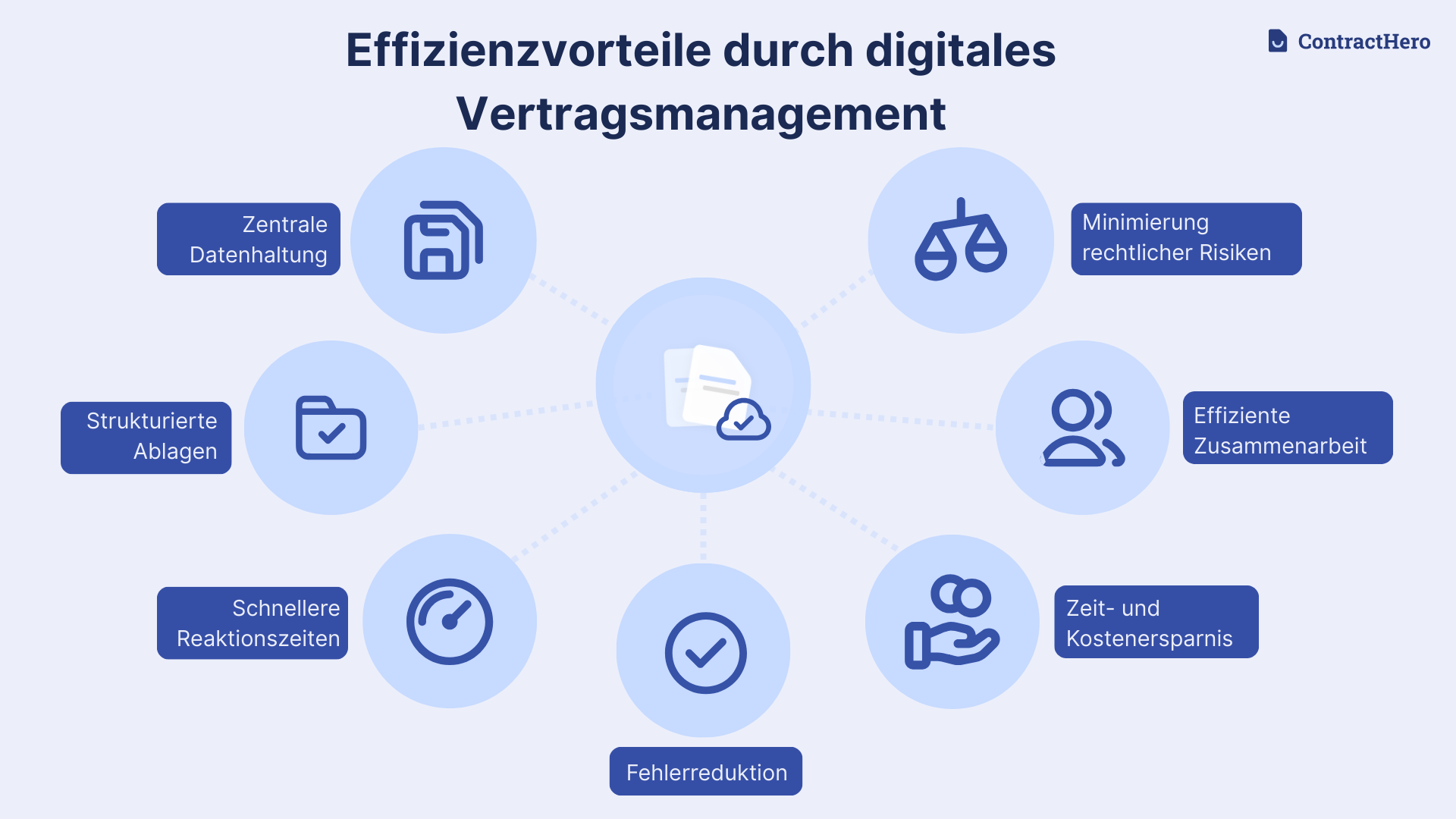
Efficient contract management improves the use of contract information for planning, evaluation, and corporate management. An appropriate system creates a reliable data basis on which obligations, terms, and costs can be consistently analyzed. Structured automation of recurring steps can accelerate processes and reduce manual coordination.
Instead of isolated individual documents, a systematically recordable contract portfolio is created. Processes are documented uniformly and can be evaluated across departments. This not only improves operational coordination, but also the quality of forecasts, budget planning, and strategic decisions.
Centralized reporting enables structured evaluation of contract types, cost developments, and terms. In addition, AI-supported document analysis can automatically capture relevant content, thereby supporting the review of larger contract portfolios.
The efficiency gains result primarily from the structured availability and analyzability of all contract information.
Digitization in contract management: Status quo in Germany
However, the extent to which these efficiency potentials are already being exploited varies considerably across Germany. Digitalization in contract management has progressed, but has not been implemented uniformly. Many companies already use individual digital solutions or have restructured sub-processes. However, the consistent integration of all contract processes has not yet been established across the board.
Technical solutions are available and legal requirements have been established. However, in everyday business life, existing structures and new systems are often used in parallel. Some contracts are processed digitally, while others continue to be managed manually.
The status quo is therefore characterized by a transitional phase. Digital elements are integrated, but a consistent process structure does not exist in every company. As a result, the advantages of digital contract management remain only partially exploited in many organizations.
Customer example: How hhpberlin saved €100,000 in its first year with digital contract management
The example of hhpberlin shows how digitization can have a concrete impact on contract management.
Before ContractHero was introduced as a digital contract management system, there was no comprehensive record of all contractual obligations. Contract information was stored in decentralized locations, deadlines were difficult to track, and evaluations required a great deal of research.
With the structured introduction, all contracts were centrally recorded and systematically monitored. Responsibilities were clearly defined and contract data made uniformly evaluable. This created a robust basis for controlling and management.
The result: in just the first year, digitization in contract management led to savings of €100,000 and significantly greater transparency regarding terms and obligations.
→ Read the full success story here or talk to us directly about your current situation.
Implementation of a digital contract solution
Successful implementation of a digital contract management system requires structured preparation. Existing contract types, responsibilities, and filing formats are reviewed in order to create a uniform system basis.
Typical steps are:
- Recording and structuring existing contracts
- Definition of roles and permissions
- Selecting suitable contract management software
- Structured transfer of existing contracts into the system
- Onboarding of the responsible users
After selection, processes, access rights, and approval steps are set up in the system according to internal requirements. The software maps the defined processes but does not control them independently.
The contracts are then recorded in an audit-proof manner and made available centrally. A gradual introduction facilitates integration into existing workflows and supports stable use within the company.
Customer example: Digital contract management implementation at empact
The example of empact illustrates how digital contract management can be implemented in a growing business environment.
Before the introduction, there was no consolidated overview of contract terms and obligations. Contract information was stored in different areas, which meant that evaluations and management decisions required additional coordination efforts.
As part of the implementation of ContractHero, existing contracts were centrally recorded and uniformly structured. Responsibilities were clearly defined and relevant contract data was systematically made available. This improved the controllability of the entire contract portfolio.
The introduction was carried out in stages and was based on empact's organizational requirements. Today, the company has a centralized and reliable contract overview that supports operational decisions and enables the structured further development of internal processes.
→ Read the full success story here or talk to us directly about your current situation.
Security aspects of digital contract management
A digital contract management system must ensure that sensitive contract data is protected, processed in a traceable manner, and archived in compliance with regulations. Contract information is among the most sensitive data in a company. Accordingly, security in digital contract management is an essential prerequisite for the responsible use of such solutions.
The focus is on protecting business-critical information and complying with regulatory requirements. Contract management systems can use encryption when transferring and storing data. Role-based access concepts enable precise control of permissions so that only authorized persons can view relevant contract documents.
For companies in the EU, GDPR compliance and data processing in European data centers are particularly important. Certifications such as ISO 27001 prove that information security processes are structured, established, and regularly reviewed.
Security is therefore a key factor in minimizing risks and protecting contract information in the long term.
Conclusion: Digital contract management as a strategic lever
Efficient digital contract management creates the structural conditions necessary to systematically manage contractual obligations and secure them organizationally. Through uniform recording, clear responsibilities, and a robust database, the contract portfolio becomes a controllable component of corporate management.
This transforms contract management from an administrative task into a strategically relevant function. Decisions are no longer based on individual documents, but on consistently available contract information. Risks can be identified at an early stage, terms can be planned, and resources can be deployed in a targeted manner.
Modern contract management software such as ContractHero helps companies manage contracts centrally, map processes transparently, and evaluate relevant data in a structured manner. As a cloud-based solution, ContractHero supports the traceable organization of the entire contract portfolio. Contract data is processed in ISO 27001-certified data centers in Germany, ensuring that high security and data protection requirements are reliably met.
Companies that modernize their contract processes in a structured manner improve the controllability of their obligations and establish clear responsibilities.
.svg)

.avif)




_BestSupport_QualityOfSupport%20(5).png)




.avif)