


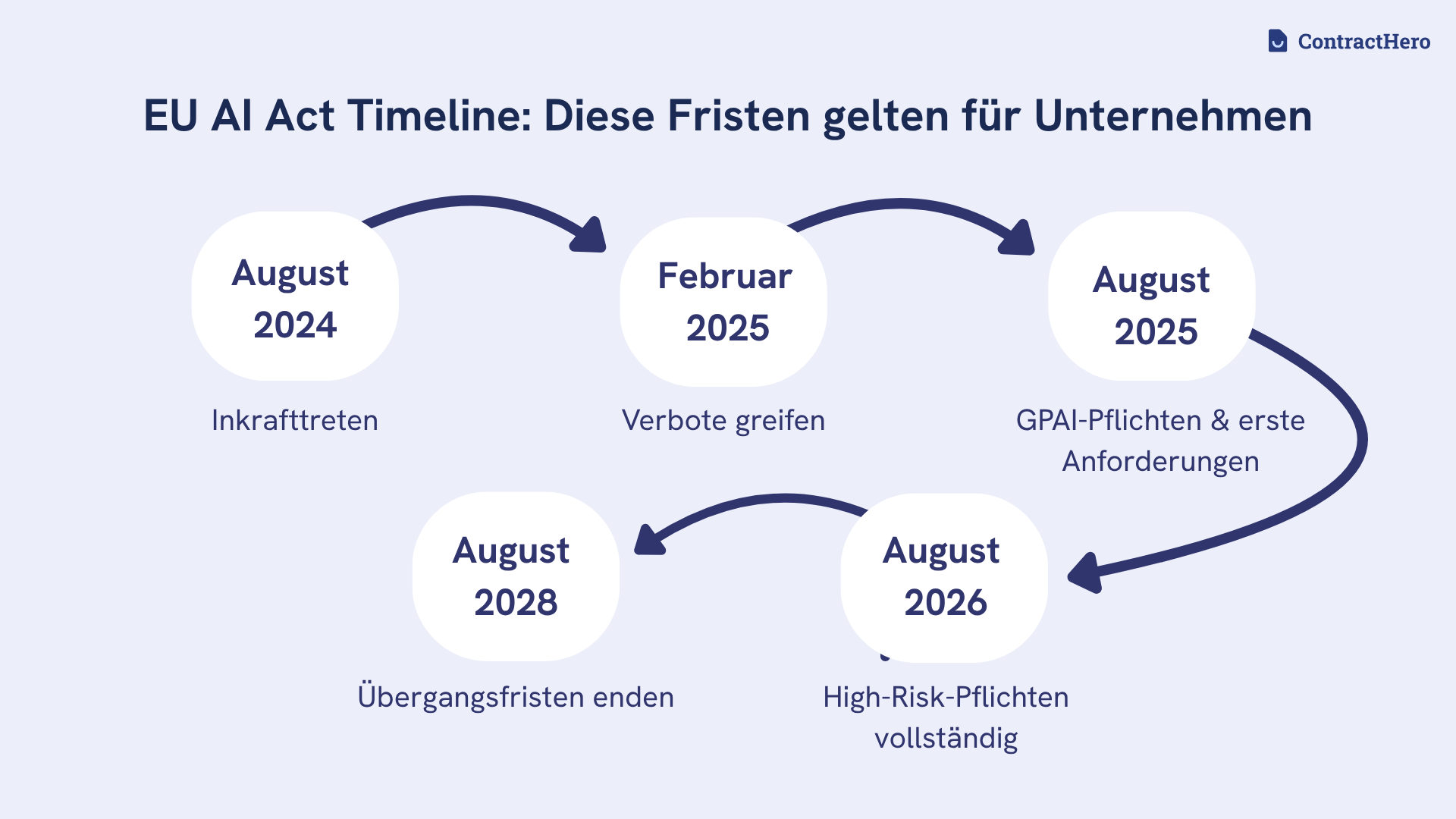
For many companies, AI is no longer just a pilot project but an integral part of everyday processes: from automated creditworthiness assessments to AI-powered contract analysis. What used to operate largely without binding rules is now undergoing a fundamental change. The EU AI Act has been in effect since August 2024 and will be implemented in phases: initial bans starting in February 2025, requirements for high-risk systems beginning in August 2026. Anyone using AI systems must act now. In this article, you will learn what the EU AI Act specifically requires, which risk classes apply, who the regulation affects, and how structured contract management helps to document AI usage in a traceable manner and meet compliance requirements.
What is the EU AI Act?
The EU AI Act is a European regulation governing artificial intelligence. Unlike national laws, it applies directly in all EU member states and does not need to be transposed into national law; this means that its provisions are immediately binding and apply without the need for additional national legislation.
But what exactly is the EU AI Act? It defines the conditions under which AI systems may be developed, deployed, and used. The goal is to establish uniform rules for the use of AI and to systematically mitigate risks.
Companies must be able to demonstrate how their AI systems work, how they are used, and how risks are managed.
The EU AI Act therefore affects not only developers but also companies that use AI systems. Traceability is key. Without structured documentation and clear processes, it is difficult to meet the requirements.
Objectives of the EU AI Act
What is the EU AI Act aiming to achieve? At its core, the regulation pursues three key objectives: security, trust, and a level playing field.
A key objective is the protection of fundamental rights. AI systems should not make discriminatory or manipulative decisions, for example in the automated screening of job applications, the assessment of creditworthiness, or the personalized delivery of content. At the same time, applications that are designed to influence or disadvantage people should be prevented.
In addition, the EU AI Act establishes a uniform legal framework within the European Union. Companies are provided with clear guidelines that apply in all member states. This reduces regulatory uncertainty and facilitates the use of AI in the European market.
Another key focus is transparency. Users and businesses should be able to understand how AI systems work and what risks are involved.
At the same time, innovation must remain possible. That is why the EU AI Act takes a risk-based approach, with requirements tailored to the specific use case.
Risk classes in the EU AI Act
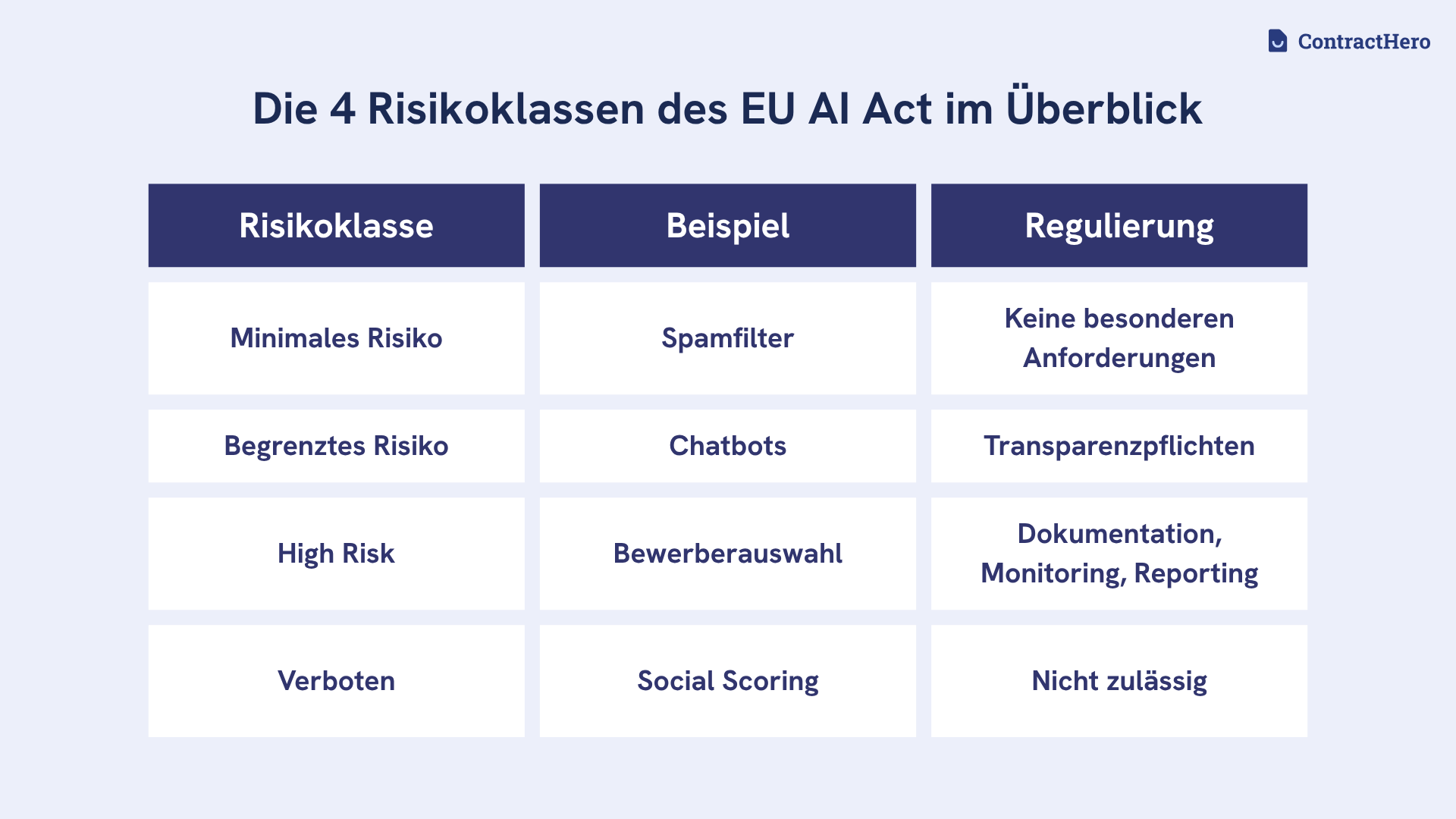
What risk categories does the EU AI Act define? The regulation classifies AI systems into four categories based on the risk they pose to security and fundamental rights.
The lowest level includes systems with minimal risk. No specific regulatory requirements apply to these systems. Examples include spam filters and AI-powered spell-checkers.
In addition, there are systems that pose limited risk. Typical examples include chatbots used in customer service or generative AI applications that create text or images. In these cases, transparency requirements—such as labeling AI interactions—are particularly important.
The next category consists of high-risk AI systems. These include applications in sensitive areas such as personnel decisions, critical infrastructure, or financial systems. Examples include applicant screening systems, creditworthiness checks, and AI in medical applications. These systems are subject to extensive requirements regarding documentation, monitoring, and risk management.
The highest category consists of prohibited systems. These are considered incompatible with European values and may therefore not be used. They include, for example, social scoring or AI systems designed to manipulate people.
Ultimately, the risk categories in the EU AI Act are decisive for regulation. As a general rule, the higher the risk, the stricter the requirements.
What does the EU AI Act prohibit?
What is prohibited under the EU AI Act? The EU AI Act completely bans certain AI systems if they are classified as posing an unacceptable risk.
This includes, in particular, AI applications that specifically manipulate or influence human behavior, such as systems that subtly steer users toward certain decisions. Social scoring is also prohibited. In this context, AI systems evaluate individuals based on their behavior or characteristics, for example, to assess creditworthiness or social status.
The use of AI that specifically exploits the vulnerabilities of certain groups is also prohibited. This includes, for example, applications that influence children or vulnerable individuals through personalized content.
In addition, certain biometric AI applications are heavily restricted or prohibited. These include, for example, AI-powered emotion recognition in sensitive contexts such as the workplace or educational institutions.
These prohibitions are binding throughout the EU. Companies are not permitted to develop, offer, or use such AI applications.
What are the requirements for companies?
What requirements does the EU AI Act impose on companies? Essentially, the regulation requires organizations to manage the use of AI systems in a structured manner and to document this process in a transparent way.
Additional requirements apply to high-risk AI systems. These include structured risk management, technical documentation, and continuous monitoring during operation. One example is AI used to pre-screen job applications. In such cases, it must be clearly documented what criteria are used to make decisions and whether any biases are present.
Serious incidents must be reported. This applies when an AI system makes incorrect or security-related decisions that result in risks or harm. Such incidents must be identified, assessed, and reported to the relevant authorities.
The biggest challenge lies in implementation. Companies need clear processes, defined responsibilities, and a centralized database to meet these requirements on a day-to-day basis.
Who is affected by the EU AI Act?
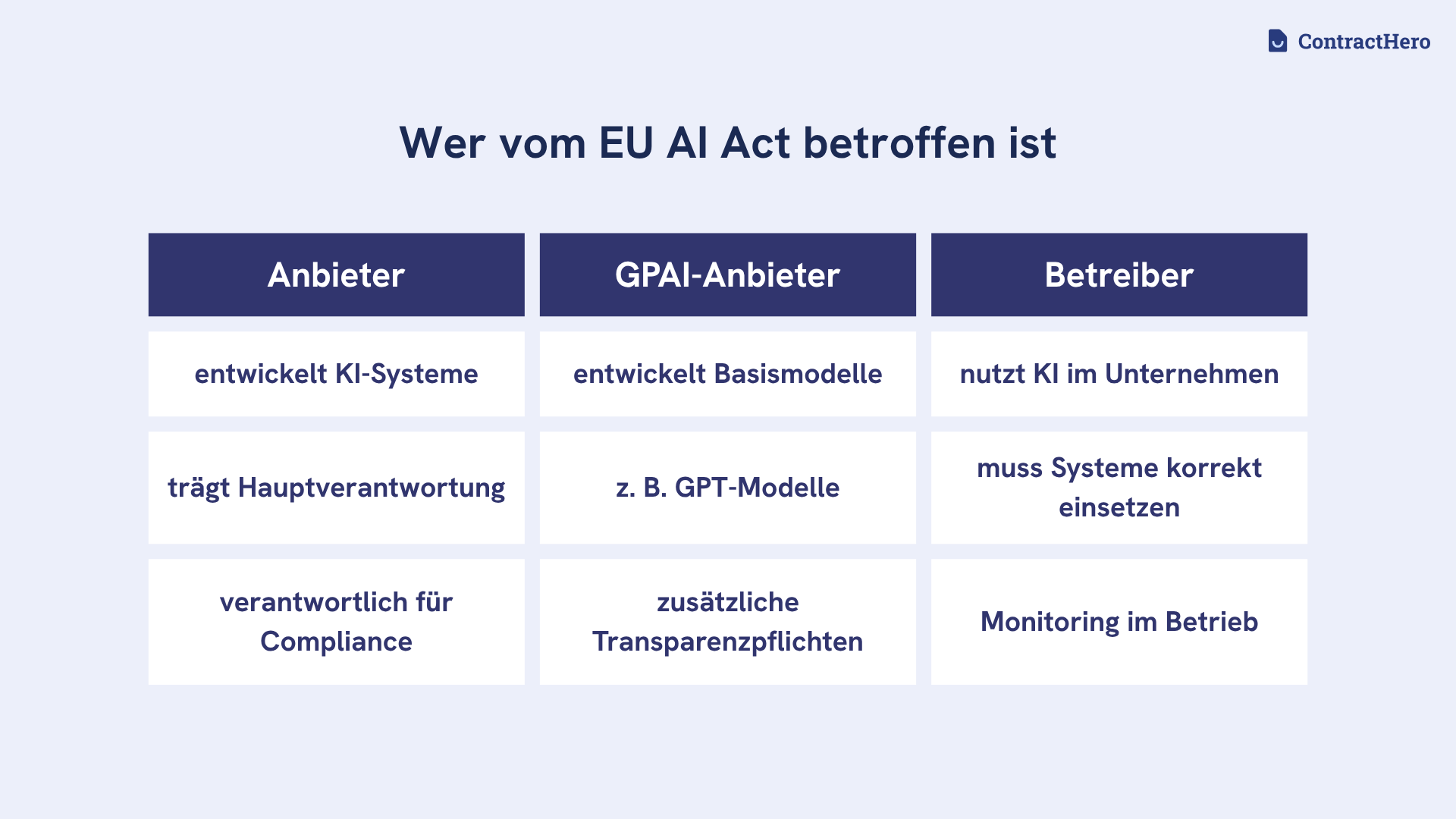
Who is affected by the EU AI Act, and to whom does it apply? In general, the regulation applies to all companies that develop, provide, or use AI systems.
A distinction is made between different roles. Providers develop or distribute AI systems and bear primary responsibility for compliance with the requirements.
Even companies that do not develop AI systems themselves but use them in their own operations are subject to the EU AI Act. These are referred to as operators. They are particularly affected if they use high-risk systems or make decisions based on AI.
In addition, the regulation applies to providers of “general-purpose AI.” These providers develop AI models with a broad range of applications that are not designed for a single use case but can be integrated into various systems. The difference from traditional providers is that they do not provide a ready-made application, but rather a foundation on which companies can build their own AI applications.
Article 4 & Training Requirements
The EU AI Act also includes specific training requirements. Article 4 of the EU AI Act requires companies to ensure that employees have sufficient knowledge to work with AI systems.
This EU AI Act training requirement applies in particular to individuals who use or monitor AI systems or make decisions based on AI. Companies must therefore implement targeted EU AI Act training to ensure safe and compliant use.
The goal of these training sessions is to improve understanding of risks in practical use and to prevent misuse. Employees should be able to identify anomalies, use systems correctly, and apply regulatory requirements in their daily work.
The training requirement under Article 4 of the EU AI Act is therefore not merely a formality, but a necessary foundation for the safe and responsible use of AI.
Implementation of the EU AI Act in Germany
How is the EU AI Act being implemented in Germany? Since it is an EU regulation, the EU AI Act applies directly and does not need to be transposed into national law.
Nevertheless, national structures are needed for implementation. Germany must designate the relevant supervisory authorities and organize enforcement. It is currently expected that existing agencies will be involved, such as the Federal Office for Information Security and other specialized agencies, depending on the area of application.
For businesses, this means that the requirements apply directly and must be implemented independently. At the same time, the specifics of oversight and enforcement are being defined at the national level. Organizations must therefore familiarize themselves with the requirements early on and establish appropriate processes.
Criticism of the EU AI Act
What are the criticisms of the EU AI Act? A key criticism of the EU AI Act is the complexity of the regulation. The multitude of requirements and the classification into risk categories make implementation challenging and difficult to navigate for many companies. At the same time, the administrative burden increases significantly, as documentation, monitoring, and reporting require additional resources and clearly structured processes.
The EU AI Act is also the subject of critical debate when it comes to innovation. Some companies fear that strict regulations could slow down the development and adoption of AI systems. At the same time, however, the regulation is also seen as an opportunity, as it establishes a clear framework and can strengthen trust in AI systems in the long term.
Conclusion
The EU AI Act establishes, for the first time, a clear framework for the use of artificial intelligence in Europe. For businesses, this means one thing above all else: as soon as AI systems are deployed, their use and behavior must be systematically documented, monitored, and, if necessary, reported.
The requirements range from risk assessment and technical documentation to clear reporting processes during ongoing operations. High-risk systems, in particular, require clear processes and documentation. What matters most is not so much the technology itself, but the ability to provide information about a system at any time—such as how it works, how it is used, and whether any incidents have occurred.
At the same time, it becomes clear that many of the challenges are not technical in nature. A lack of oversight, unclear responsibilities, and fragmented information make implementation difficult in practice.
The EU AI Act requires companies to address this very issue. By establishing structures early on, clarifying responsibilities, and making relevant information centrally available, companies can reliably meet reporting requirements and reduce regulatory risks.
.svg)






_BestSupport_QualityOfSupport%20(5).png)





.avif)