

.avif)
Many companies already use specialised software solutions for sales, finance, and contract management. In practice, however, these systems are often not connected to each other. Customer data is maintained in CRM, invoices are created in ERP, and contract information is stored in a separate application. This means that data is managed separately and therefore also maintained, analyzed, and used separately or multiple times.
The result is duplicate entries, outdated information, and manual exports. The consequences are even more serious: data is lost, deadlines are missed, and compliance risks increase. This is precisely where the potential of application programming interfaces (APIs) lies. They connect systems, create consistent data flows, and enable collaboration that transcends departmental boundaries. APIs are therefore not purely an IT issue, but a strategic tool for greater efficiency, control, and transparency in all aspects of contract management.
What is an API and why is it so important in contract management?
An API, short for Application Programming Interface, is a standardized interface through which software systems exchange data. It defines exactly what information a system provides, how other applications can access it, and in what format this exchange takes place.
From a technical perspective, an API serves as an intermediary layer between applications. It enables data such as contract status, amounts, or deadlines to be automatically retrieved, created, or updated without the need for manual intervention by users. This establishes a secure and reproducible flow of information between systems. Unlike integrations, which usually map specific use cases (e.g., "connect CRM with e-signature"), an API forms the basis for this. An integration is like a finished cable, while the API is the copper inside it. Structured data flows between all participating systems via this infrastructure.
This is particularly crucial in contract management: a powerful API ensures that contract information, documents, metadata, and deadlines can be automatically synchronized with other systems, such as CRM, ERP, or BI solutions. This keeps the database consistent, reduces risks from duplicate or outdated entries, and ensures that workflows run smoothly across departmental boundaries.
This means that contract management is not operated as an isolated function, but as an integral part of a networked, data-driven corporate landscape.
Typical API use cases in contract management
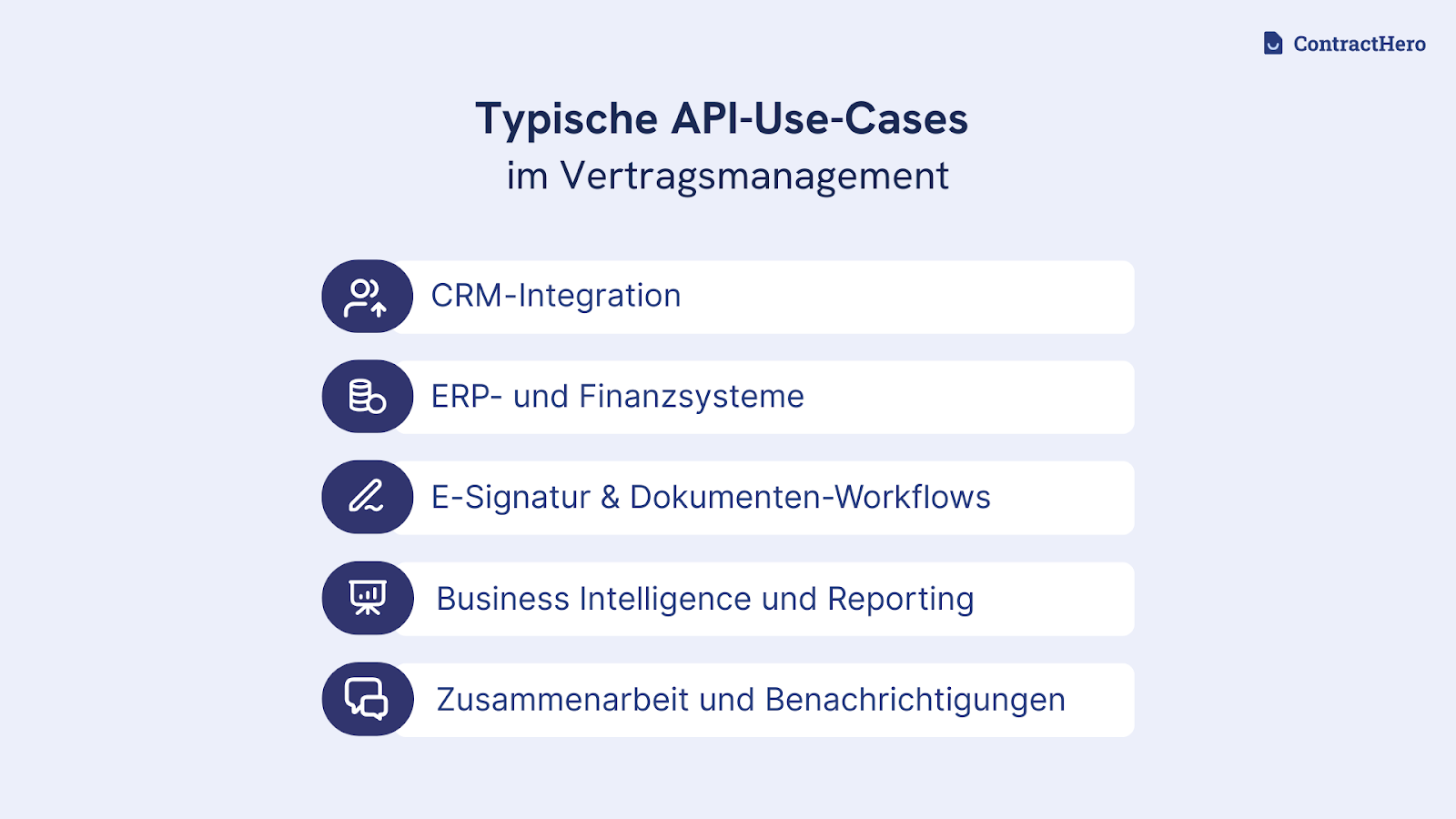
CRM integration: From closing the sale to signing the contract
When a sales process is successfully completed in a CRM system such as HubSpot or Salesforce, it means that the customer has accepted the offer and a binding contract can be prepared. At this point, all relevant information is automatically transferred from the CRM to the contract management system (VMS) via the API: customer data, contract values, terms, contact persons, or project-specific details. Contract management solutions such as ContractHero use this data to immediately create a draft contract or fill in a predefined contract template with the transferred data. If desired, internal approval processes can also be initiated, for example by management or the legal department, before the contract is sent for digital signature.
result
The entire transition from winning the deal to drafting the contract is automated and requires no manual intermediate steps. Sales, legal, and finance teams work with the same, up-to-date data, which saves time, reduces errors, and significantly speeds up the closing process.
ERP and financial systems: Full control over commitments
In many companies, contracts and financial data are kept separate. While the ERP system records bookings and payments, contract information is often stored in separate files or folder structures. The result: a lack of transparency regarding recurring obligations, unclear budget allocations, and a high level of manual effort required for coordination between departments. An API can be used to automatically transfer contract values, payment deadlines, or cost centers to ERP systems such as SAP or DATEV. Modern contract management solutions such as ContractHero transfer the relevant contract information to the financial system in a structured manner and keep it continuously synchronized.
result
Finance departments no longer need to consolidate information from different sources or check it manually. Budget planning, forecasting, and cash flow analyses become more accurate, provisions can be made at an early stage, and unnecessary costs can be avoided. At the same time, the risk of incorrect bookings or duplicate payments is reduced—a decisive step toward efficient, data-driven financial management.
E-signature & document workflows: A seamless way to obtain legally valid signatures
In many companies, the signing process is still handled manually: contracts are sent by email, printed out, signed, and scanned back in. This process takes a lot of time, can lead to different versions of documents being in circulation, and carries the risk of deadlines or approvals being overlooked.
With a solution such as ContractHero, these steps can be mapped entirely digitally. Contracts are created centrally, approved internally, and then submitted for digital signature. The role of the API is to transfer the results of this signature process to other systems. Once a contract has been signed, its status can be automatically reported to other applications via the interface, for example to a CRM, ERP system, or collaboration tools. This makes it clear which contracts have been concluded, which are still under review, and which steps are next.
result
Theentire process, from preparation to legally valid signature, is digitally mapped and traceable. Teams save time, avoid errors caused by outdated versions, and receive complete documentation of all completed contracts, which is a clear advantage during audits or internal reviews.
Business intelligence and reporting: Contract data as a basis for decision-making
For CFOs and management teams, access to up-to-date contract data is crucial. In practice, however, this information is often spread across multiple systems or only available via manual exports. This complicates analysis, delays decisions, and leads to an incomplete view of ongoing obligations or risks.
A contract management system such as ContractHero uses an API to provide structured contract data to external parties. This includes key figures on contract volume, terms, notice periods, and risk classes, among other things.
Business intelligence tools such as Power BI access these interfaces, automatically transfer the data, and link it to financial or project data. This allows dashboards, reports, and analyses to be created without having to manually export or prepare data.
result
The automatic connection to BI tools creates a reliable and always up-to-date data basis. Trends can be identified early on, expenses can be analyzed precisely, and forecasts can be made without manual table maintenance. Management and finance teams gain a clear view of all contract-related key figures, make decisions based on reliable data, and at the same time reduce the effort required for reporting and reconciliation. Risks become visible more quickly and can be managed proactively.
Collaboration and notifications: Inform the right people at the right time
In many organizations, important deadlines or contract changes get lost in day-to-day business. Information is scattered across emails, local reminders are overlooked, and responsibilities are not clearly defined. This leads to missed termination dates, extended terms, or internal coordination problems. Using webhooks, notifications from contract management systems such as ContractHero can be forwarded directly to other applications such as Slack, Microsoft Teams, or email systems. As soon as a contract expires, a deadline is approaching, or the status changes, the responsible persons automatically receive a notification. Notifications can be set up to inform the appropriate individuals or teams, depending on the contract type, company, or type of deadline.
result
Teamsremain informed and capable of acting at all times. Deadlines are met, responsibilities are clearly assigned, and coordination is faster. This reduces risks, strengthens internal communication, and ensures greater security in daily contract management.
Standard integration or custom connection: Which solution is right for your company?
Many systems today come with ready-made standard integrations. They are quick to implement, cost-effective, and cover typical scenarios such as the transfer of basic master data or the triggering of simple workflows. In practice, however, they are like off-the-rack shirts: they work in everyday life, but do not always fit your own structures and processes exactly.
This is particularly evident in contract management. Every organization works with its own data fields, specific approval steps, and individual compliance requirements. A ready-made integration can only reflect this diversity to a limited extent. Fields such as contract type, mandate number, or risk class often have no suitable counterpart. Differentiated roles and rights or more complex processes can also only be implemented to a limited extent.
If requirements exceed what a standard integration can offer, a REST API provides the necessary flexibility. The API itself is deliberately kept generic. It provides structured endpoints that can be used to develop individual connections – precisely tailored to your own data schema, the desired workflows, or the existing system landscape. The connection to systems such as SAP, HubSpot, or DATEV can thus be designed in a targeted manner. Security mechanisms, authorizations, and governance follow the company's internal guidelines.
Although custom implementations of APIs require more effort than ready-to-use standard integrations, they offer significantly more flexibility in the long term. Data flows can be precisely controlled, workflows can be mapped accurately, and integration costs during operation can be reduced. At the same time, the risk of incorrect or inconsistent data sets is reduced.
A flexible API is therefore not just a technical interface, but an essential component of modern, scalable contract management.
Benefits of an API-based CLM architecture
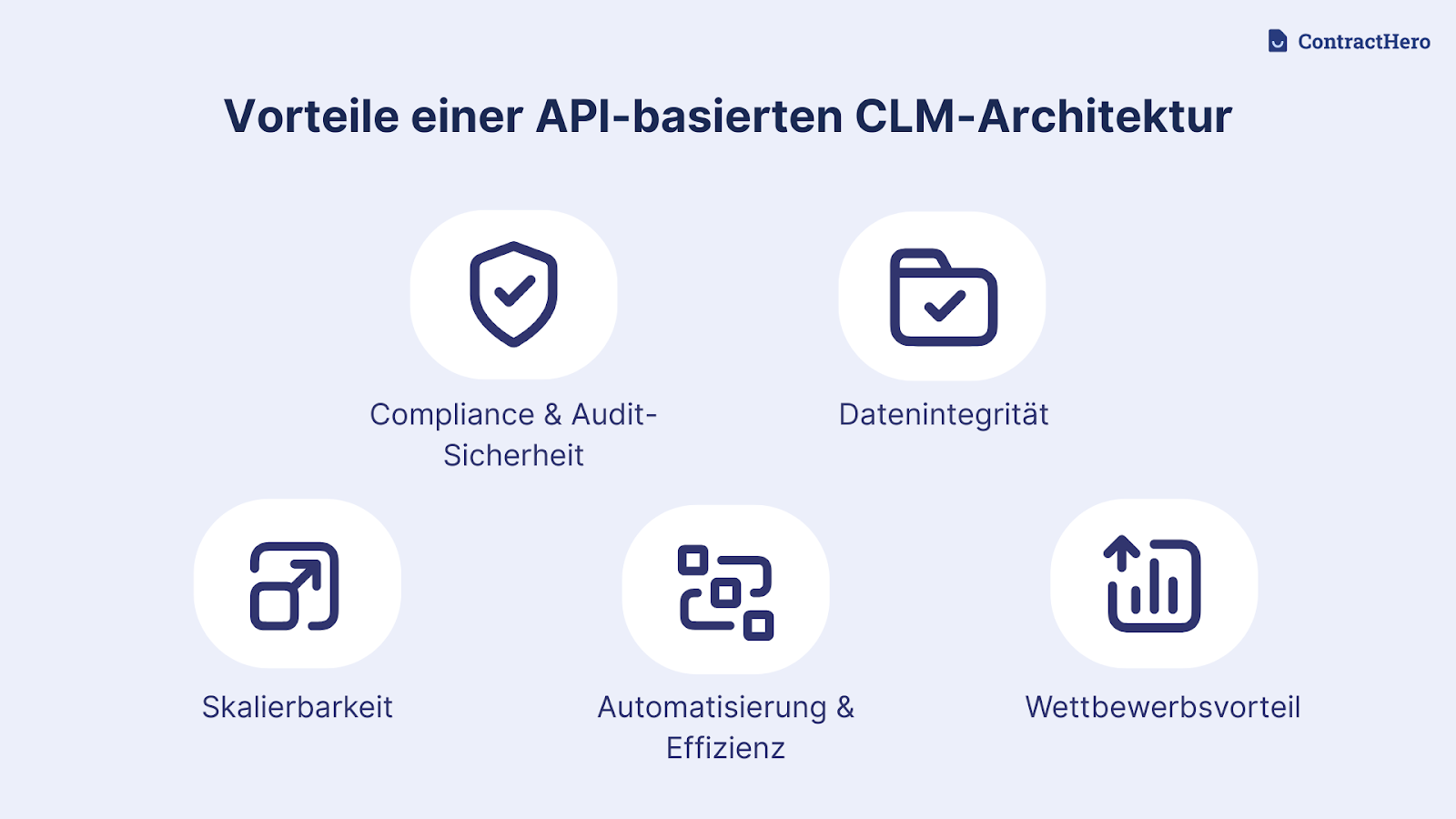
A modern CLM system with a powerful, well-documented API creates the basis for sustainable digitization. If contract data is not managed in isolation but specifically integrated into other systems, this results in several key advantages:
- Automation & efficiency: Processes run continuously and without media discontinuity.
- Data integrity: All systems access the same database ("single source of truth").
- Scalability: New tools can be easily docked without modifying the core platform.
- Compliance and audit security: Through clearly defined access levels, logs, and permissions.
- Competitive advantage: Companies gain speed, transparency, and decision-making ability.
Challenges & Best Practices
APIs only deliver their full benefits if their introduction is well prepared. An important first step is to involve IT at an early stage. This allows technical requirements, security requirements, and interfaces to be clarified quickly before specialist departments start planning in detail.
The next step is to reconcile the data properly. Contract fields and master data should be set up in such a way that each piece of information is clearly assigned and does not need to be corrected later. Before the system goes live, everything should be tested in a test environment. There, you can check whether the fields are transferred correctly, triggers work, and access rights are correct.
Once the API is in use, it still needs attention. Simple monitoring of accesses, logs, and any errors helps to keep integrations stable. It also makes sense to start with a clearly defined use case and expand the connection step by step, rather than mapping all special cases from the outset.
This means that the API is not a one-off action, but rather a reliable component of your own infrastructure, forming the basis for automation, clean reporting, and contract management that supports your company in the long term.
Conclusion: APIs make contract management scalable
Contract management does not end with storing documents; it begins where data is used intelligently. APIs are the link between contracts, people, and systems. Whether for CFOs, legal teams, or CEOs, those who seamlessly integrate their contract data into the company workflow gain transparency, speed, and security. And those who rely on an API lay the foundation for contract management that grows with the company—flexible, secure, and future-proof.
.svg)


.avif)




_BestSupport_QualityOfSupport%20(5).png)




.avif)