In employment relationships, the notice period governs when a contract actually ends after a notice of termination. It ensures that the employment relationship does not end abruptly, but rather that both parties have time for planning and handover. Depending on legal regulations, employment contracts, or collective bargaining agreements, different notice periods may apply. This glossary entry explains the most important basics, legal regulations, and calculation steps related to the notice period and shows what employees and employers should pay attention to.
What is a notice period?
The notice period is the time span between the receipt of a notice of termination and the actual end of the employment relationship. It therefore determines how long an employment relationship continues after the notice of termination has been given.
In practice, the notice period begins as soon as the other party receives the notice of termination. The employment relationship does not end immediately, but only after the applicable notice period has expired.
The notice period creates reliability for both sides. Employees gain time to reorient themselves professionally, and employers can delegate tasks, plan replacements, and implement personnel changes in an orderly manner.
Depending on the employment contract , different notice periods may apply, for example, due to collective bargaining agreements or length of service. A fundamental distinction is made between ordinary termination with notice and extraordinary, immediate termination. The latter is only possible under strict legal conditions.
Knowing the notice period allows you to better assess and accurately calculate the end of the contract.
Overview of statutory notice periods
The statutory notice periods are regulated in the German Civil Code (BGB) and always apply unless a different regulation has been agreed in the employment contract or collective agreement.
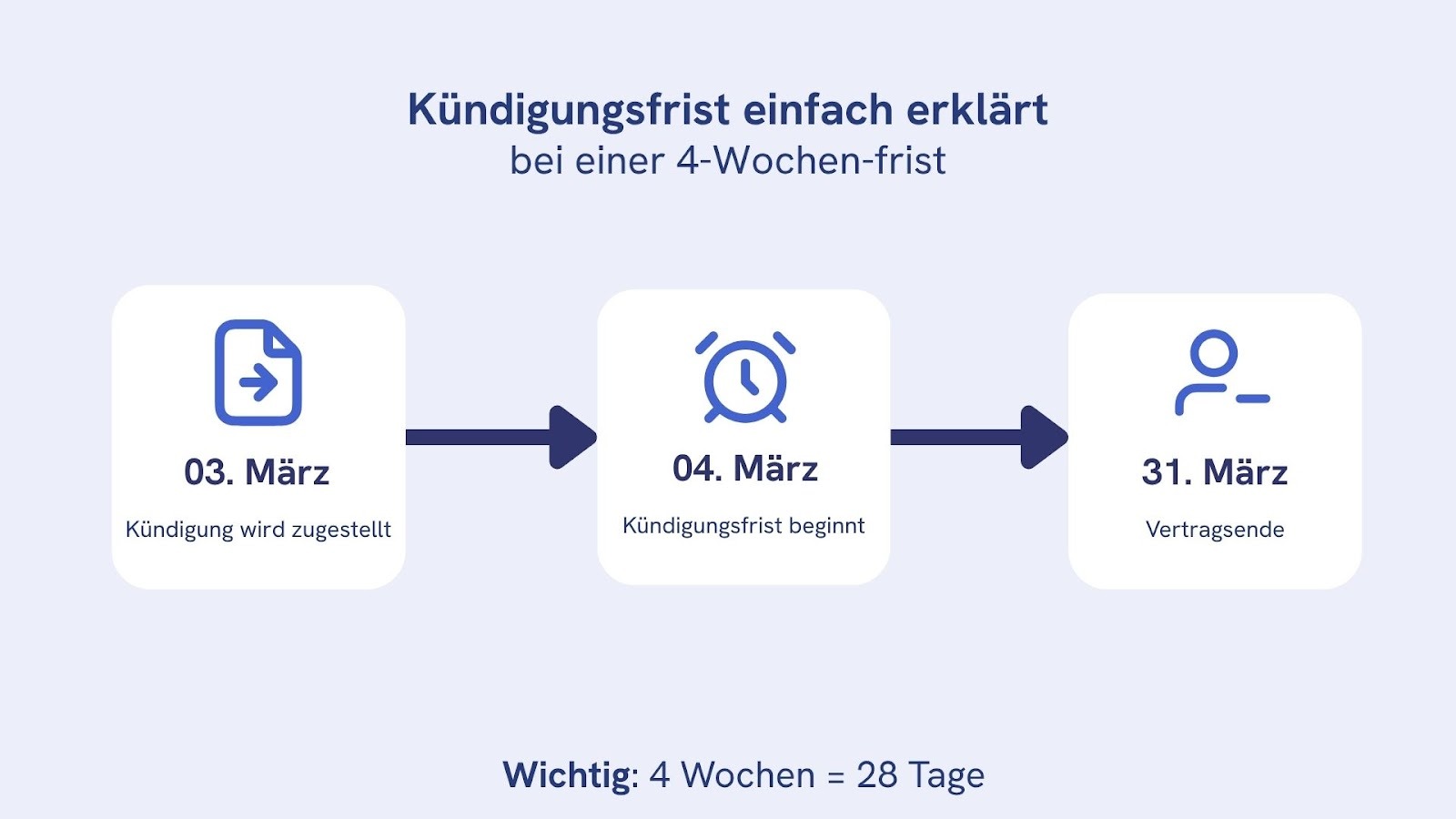
For employees, the statutory notice period is generally four weeks, either to the 15th or the end of a calendar month . It is important to note that four weeks is not equivalent to one month, but rather exactly 28 days.
During an agreed probationary period, which may last a maximum of six months, the employment relationship can usually be terminated with a notice period of two weeks to any day .
For employers, the notice period increases with the length of service. After two years of employment, it is one month to the end of the month. With longer service, it gradually increases to up to seven months.
Collective bargaining agreements may deviate from these statutory provisions and, if applicable, take precedence over the regulations in the employment contract. If the employment contract contains no specific regulation or expressly refers to the statutory notice period, the provisions of the German Civil Code (BGB) automatically apply.
The statutory notice period thus forms the central guideline for most dismissals in employment law.
Properly document the start and end of the contract
The start and end dates of the employment contract should be clearly documented. This clarifies when deadlines begin and when the employment relationship ends.
The start date of the employment contract is relevant for several reasons, including the length of service. This length of service plays a central role in determining the statutory notice period for employers. Furthermore, regulations concerning probationary periods and agreed notice periods can only be properly assessed if the start date of the employment relationship is clearly established.
Equally important is the documentation of the contract termination. This can result from a standard termination, a summary dismissal, the expiration of a fixed-term contract, or a mutual termination agreement. The decisive factor in each case is the basis on which the employment relationship was terminated and the legally valid date.
Clear documentation is crucial for correctly calculating and legally complying with notice periods. Only when the start and end of an employment relationship are clearly defined can notice periods be reliably determined and verified.
Individual contractual notice periods
In addition to the statutory notice period, employers and employees can also agree on individual notice periods in the employment contract. Such contractual notice periods specify exactly how long the employment relationship continues after a notice of termination.
Many employment contracts contain their own provisions, for example, six weeks' notice to the end of the quarter or three months' notice to the end of the month. These agreements supersede the statutory notice period, provided they have been validly agreed upon.
In practice, notice periods are often extended, especially for positions with greater responsibility or longer handover periods. This allows more time for a structured handover and an orderly succession.
Depending on the company, industry, or position, different notice periods may apply. Therefore, it is important to know the specific provisions in the employment contract and to carefully review them if in doubt. These provisions largely determine when an employment relationship ends and what notice periods must be observed in the event of termination.
Freedom of contract and contractual regulations
The possibility of individually agreeing notice periods is based on the principle of freedom of contract. This allows the contracting parties to determine the contents of an employment contract themselves.
In employment law, however, this freedom is deliberately limited. Legal regulations set the framework for contractual agreements. Therefore, any differing notice periods should always be checked for their legal validity. The aim is to ensure a balanced relationship between the interests of employers and employees.
Freedom of contract explains why individual notice periods are even possible. At the same time, it ensures that these regulations do not lead to one-sided or unreasonable results.
It thus forms the legal basis for individual agreements without negating the protective purpose of labor law.
Validity in case of differing deadlines
Not every contractually agreed notice period is automatically valid. The decisive factor is whether the specific provision complies with legal requirements and is legally permissible.
In employment law, it is particularly important to note that the notice period for employees may not be longer than that for employers. Furthermore, statutory minimum notice periods must not be undercut. These regulations serve to prevent one-sided disadvantages and ensure fair conditions for both sides.
If a contractual clause violates these requirements, it is wholly or partially invalid. In such cases, the statutory notice period applies.
Especially with individually agreed deadlines, it is therefore important to carefully examine the specific regulation and, if in doubt, to classify it legally.
Collective bargaining agreements and company agreements
In many sectors, such as the public sector, the metal and electrical industries, or retail, collective bargaining agreements apply that stipulate specific notice periods. These agreements are negotiated between employers' associations and trade unions and create uniform standards for entire sectors or companies.
Collective bargaining agreements are particularly relevant because they are binding and take precedence over individual employment contracts. They can deviate from statutory regulations and stipulate both longer and shorter notice periods. The aim is to take industry-specific characteristics into account and to create a balance between employer and employee interests.
Those who are bound by a collective agreement should therefore always check which regulations apply in the collective agreement, as these can be decisive for the notice period.
Company agreements can play an additional role. These are agreements between the employer and the works council that establish internal company regulations, such as working hours or organizational procedures. However, they do not automatically replace collectively agreed or statutory notice periods.
How to calculate the notice period
To calculate a notice period, you must first determine the date the notice of termination is received. The decisive factor is the day the notice of termination reaches the other party, for example, when it is handed to them personally or deposited in their mailbox.
The next step is to determine which notice period applies. The order of these steps is important: First, it should be checked whether a collective bargaining agreement applies. Then, the employment contract should be examined. Only if the employment contract does it contain no effective provision regarding notice periods does the statutory notice period according to Section 622 of the German Civil Code (BGB) apply.
Only then can the contract end date be calculated. With the statutory notice period for employees of four weeks to the 15th or the end of the month, simply adding 28 days is insufficient. It is also crucial to determine whether the next permissible termination date is the 15th or the end of the month.
Anyone with a desired contract end date in mind should calculate the notice period backwards from the planned termination date and determine the latest date by which the notice of termination must be received. Particular care is needed, especially considering postal delivery times, weekends, or holidays, to avoid accidentally missing the notice period.
Circumventing the notice period – what is allowed?
A notice period cannot generally be circumvented at will. It is legally binding and must be observed unless a special exception applies.
Nevertheless, there are cases in which an employment relationship ends before the end of the regular notice period, or the actual employment is terminated earlier. One possibility is a termination agreement. In this case, the employer and employee mutually agree on a specific termination date.
Another exception is extraordinary termination without notice pursuant to Section 626 of the German Civil Code (BGB). However, this requires a compelling reason and is only permissible under strict conditions. Typical examples include serious breaches of duty, criminal offenses, or a significant breach of trust.
This is distinct from the practical arrangement of the remaining time until the end of the contract. In some cases, remaining vacation days, time off, or overtime can lead to the obligation to work ending even before the legal termination of the employment relationship.
Therefore, the crucial distinction is between the legal end of the contract and the actual last day of work .
Termination agreement instead of dismissal: An alternative without notice?
A termination agreement is a mutual agreement between employer and employee to end the employment relationship at a mutually agreed-upon date. It must be in writing, otherwise it is invalid. Unlike a standard dismissal, no statutory or contractual notice period needs to be observed.
This is precisely why a termination agreement is often used as an alternative to dismissal. Both parties can not only agree on the termination date, but also regulate other points, such as garden leave, remaining vacation days, severance pay, or the letter of reference.
For employers, a termination agreement can be a legally sound solution because it often avoids lengthy disputes over dismissals. For employees, it can be advantageous if a quick job change is desired or if a new position has already been secured.
At the same time, caution is advised. A termination agreement can affect entitlement to unemployment benefits. A waiting period may be imposed. Furthermore, the option of later having the termination legally reviewed, as would be the case with a dismissal, is lost.
Therefore, a termination agreement should always be carefully reviewed before signing.
Notice period table: All deadlines at a glance
A table of notice periods helps to quickly understand the legal deadlines. Especially in employment law, it is important to distinguish whether the termination is initiated by the employee or the employer.
For employees, the standard statutory notice period after the probationary period is four weeks, either to the 15th or the end of the month . For employers, the notice period increases with the length of service.
The table provides guidance based on statutory regulations. However, individual employment contracts, collective bargaining agreements, or special regulations may lead to different deadlines. Therefore, it should always be checked which specific regulation applies.

Conclusion: The most important points at a glance
The notice period determines when an employment relationship actually ends and must therefore be correctly calculated and adhered to. However, differing regulations from laws, employment contracts, or collective bargaining agreements often make the calculation complex in practice.
The same applies to both employees and employers: check deadlines early, plan the delivery of the notice of termination carefully, and be thoroughly familiar with the applicable regulations. Only in this way can mistakes and unnecessary risks be avoided.
ContractHero helps you centrally document and automatically monitor notice periods, ensuring you always have an overview of contract durations and deadlines. This guarantees that deadlines are met and processes are managed efficiently.



_BestSupport_QualityOfSupport%20(5).png)