%20Large.avif)
Introduction to digital and electronic signatures
In many organizations, contracts have long been created, reviewed, and archived digitally. The signature is often the last step that still generates paper. Electronic signatures close this gap and make it possible to conclude contracts without media discontinuity.
What is a digital signature?
An electronic signature can be thought of as a handwritten signature in digital form. Instead of signing on paper, the entire signing process takes place digitally. The meaning remains the same.
A signature makes a statement binding and clearly attributable. It records who signed and what the signature refers to. Depending on the type of signature, it is also possible to verify the identity of the signatory more reliably and to see whether a document has been altered subsequently.
This makes electronic signatures an important component in digital contract and document processes, especially when transactions need to be completed quickly, securely, and transparently.
Creating digital signatures – step by step
Creating a digital signature is usually straightforward and takes only a few minutes.
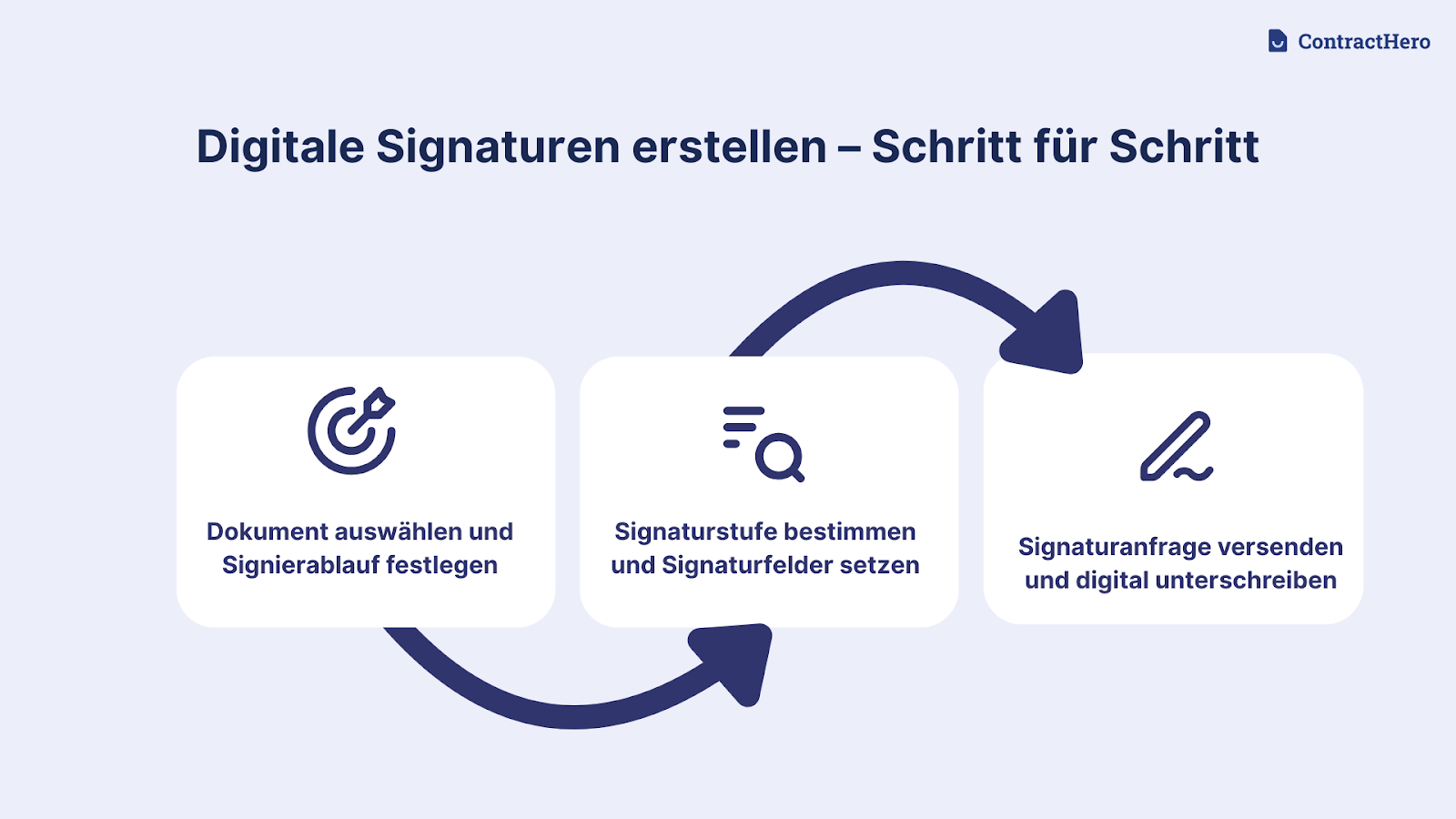
1) Select document and define signing process
2) Determine signature level and set signature fields
In the next step, select the appropriate signature level as required (simple, advanced (FES) or qualified (QES)). The signature fields are then placed in the document, e.g., signature, name, and date. This clearly defines which information is captured at which point.
3) Send signature request and sign digitally
Signatories receive an email with a secure link to the document. Verification and signing take place directly in the browser.
It is particularly helpful for companies to be able to track the signature process at any time. They can see who has already signed and where the process is currently at any time. If necessary, signatories can also reject the signature or the process can be canceled. In addition, reminders of outstanding signatures can be sent to speed up the conclusion of contracts.
With ContractHero , electronic signatures can be created directly in the software: request signatures, specify sequences (parallel or sequential), define signature positions, and track status centrally.
Choosing the right signature tool
The right solution depends on two factors: What level of legal certainty is required? And how many contracts need to be signed on average? Carefully assessing both factors helps avoid unnecessary complexity and saves costs.
1) Which signature level is really necessary?
The simple electronic signature is suitable for non-critical processes and internal approvals where speed is paramount. The advanced electronic signature is useful when identity and integrity need to be better secured and documented in a traceable manner. The qualified electronic signature is the right choice when maximum legal certainty is required or when binding regulations demand it, for example in the case of formal requirements, internal compliance, or increased risks.
2) How complex is the signature process in everyday life?
Today, many tools can add a digital signature to a contract. In practice, however, it quickly becomes more challenging: multiple signatories, fixed sequences, reminders, proxies, cancellations, inquiries. It then becomes crucial whether software can clearly map statuses, responsibilities, and evidence so that nothing "disappears in the email inbox."
3) Don't just look at the signature, look at the entire process
The signature is often just one step. What happens before and after is important: coordinating versions, filing documents, tracking deadlines and obligations, controlling authorizations, securing audit evidence. Using multiple individual solutions for this quickly leads to a loss of time and transparency. An integrated solution can significantly simplify processes because signature status, document, and contract history are centrally available in one place.
4) Practical checklist for tool selection
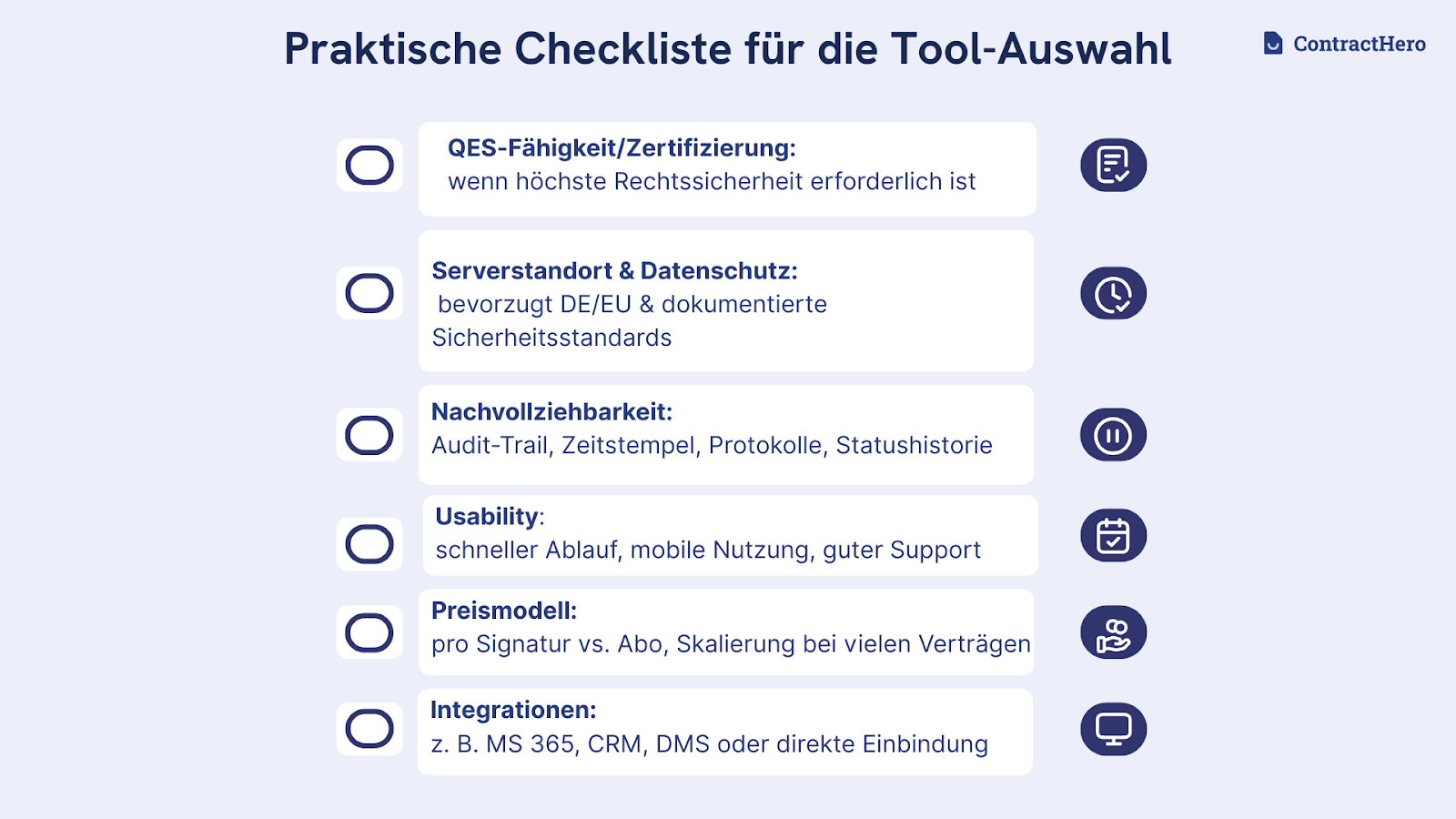
- QES capability/certification: when maximum legal certainty is required
- Server location & data protection: preference for DE/EU and clearly documented security standards
- Traceability: audit trail, timestamps, logs, status history
- Usability: fast process, mobile use, clear user guidance, good support
- Pricing model: per signature vs. subscription, scaling for multiple contracts
- Integrations: e.g., MS 365, CRM, DMS, or direct integration into existing processes
For SMEs, it is often crucial to be able to get started easily and achieve initial results quickly. For larger companies, automation, authorization concepts, audit trails, and a clear overview of many parallel processes become more important. Platforms with integrated signatures bundle these steps in one system, without additional tools that need to be maintained in parallel.
Applying the signature
Electronic signatures become relevant whenever communication and contracts are concluded digitally, i.e., between individuals or companies who often do not meet face to face. For legally binding transactions to work online, two things must be reliably clarified: who signed (identity) and whether the content has remained unchanged (integrity). This is exactly where digital signatures come in: they create a legally secure framework in which consent can be clearly assigned and any manipulation of the contract can be detected.
In practice, the benefits are particularly evident when contracts are created and processed digitally anyway. In such cases, it seems like a detour to print out documents, sign them, send them by mail, or scan them, only to then store them digitally again. An electronic signature eliminates this media discontinuity. The entire process remains digital, faster, and traceable, without losing its binding nature.
Digital signatures in contracts and documents
Electronic signatures are particularly valuable because they significantly simplify contract and document processes. Instead of printing, signing, scanning, and sending back, consent is given digitally and clearly documented.
From a legal perspective, contracts can generally be concluded digitally. The reason for this is the principle of freedom of form, which applies to numerous legal transactions in Germany. The decisive factor for the conclusion of a contract is the clear declaration of intent by both parties. Nevertheless, it is important to know that there are exceptions. For certain contracts and documents, the law expressly requires the written form, i.e., a handwritten signature on paper (Section 126 BGB). In such cases, the written form can often be replaced by the electronic form, but only with a qualified electronic signature (QES) (Section 126a BGB). At the same time, there are situations in which the electronic form is expressly excluded: for terminations and termination agreements , for example, the written form is mandatory; digital signatures are not permitted here (Section 623 BGB). This is precisely why it is always worth taking a quick look before using an electronic signature to see whether the written form is required in the specific case or whether the electronic form has been excluded.
The legal basis for qualified digital signatures
In principle, contracts in Germany are not subject to any formal requirements. This means that a contract may be concluded digitally. The decisive factor is that both parties clearly express their intent.
Only for certain types of contracts does the law prescribe a specific form, e.g., written form with signature. As soon as the law expressly requires written form, "any click" or a typed name is often not sufficient. This is precisely why there is a substitute in electronic form, which is clearly regulated in German law:
If the written form is to be replaced by the electronic form, the electronic document must be provided with a qualified electronic signature (QES).
This also answers the key question of why QES is so special. It is the signature level that is legally designated to replace the written form digitally. In practical terms, this means that if a document bears a QES and the electronic form is permissible, it is treated legally as if it had been signed with a pen.
eIDAS Regulation
The technical and legal basis for electronic signatures in the EU comes from the eIDAS Regulation. It specifies what a QES must fulfill. The QES is not simply "a digital signature," but a standardized security and verification system. Its high evidential value results primarily from these components:
- Unique assignment to a person: The signature is assigned to a specific person.
- Reliable identification: Before use, the identity of the signatory is verified (depending on the procedure, e.g., ID procedure).
- Qualified certificate: The signature is based on a qualified certificate from a qualified trust service provider (QTSP).
- Document integrity: Changes made after signing are detectable, and it can be proven that the document has remained unchanged since signing.
In short: QES is equivalent to a handwritten signature because both the law and EU standards ensure that identity, accountability, and immutability can be reliably verified.
IT security of digital signatures
A digital signature is validated in several steps to ensure that the signature is authentic and that the document has not been tampered with:
- Key generation: An algorithm generates a private key (secret) and a public key (freely accessible).
- Creation of a hash value (string of numbers): An algorithm is used to create a digital fingerprint (hash value) from the file, which represents the content of the document.
- Encryption of the hash value: The hash value is encrypted with the signer's private key and forms the digital signature.
- Verification by the recipient: The recipient decrypts the signature using the sender's public key and independently creates a new hash value from the received document.
- Hash value comparison: The new hash value is compared with the decrypted hash value. If both match, the signature is authentic and the document is unchanged.
This allows for reliable verification after the fact whether a document has remained unchanged since it was signed and who signed it. The signature is linked to verifiable information and log data, ensuring that the process remains transparent and traceable. Any subsequent changes to the document will be detected during verification, which significantly increases the security and credibility of digitally signed documents.
Digital signatures with timestamps
An additional safeguard to the qualified electronic signature (QES) is the electronic time stamp. While the QES primarily proves who signed and that the document has not been altered unnoticed since the signature, the time stamp provides reliable proof of when a document was available in exactly this version.
In simple terms, it works like this: A digital checksum (known as a hash value) is generated from the document. This hash is like a unique "fingerprint" of the file. A certified time stamp authority (TSA) adds the date and time to this fingerprint and returns the time stamp. If the document is changed even slightly at a later date, a different hash is created – and the deviation is immediately apparent. This makes it easy to check whether the file has remained unchanged since the time stamp was created.
Electronic signature for public authorities
Electronic signatures are also generally permittedwhen communicating with public authorities . The decisive factor is the form required by the respective procedure. In some cases, a simple or advanced electronic signature is sufficient, while in others, a qualified electronic signature (QES) is expressly required due to the need for verifiability.
A concrete practical example is the waste management verification procedure (eANV): According to Section 17 (1) of the Verification Ordinance (NachwV), QES must always be used—with a few exceptions—because it ensures the clear traceability of signed documents. A "signature on the display," as used by parcel services, does not meet these requirements.
In addition, there are often documents in the public sector where the focus is not on a personal declaration of intent, but rather on proof of origin. This is where the electronic seal comes into play. It is technically related to signatures, but is assigned to an organization (legal entity) and is suitable wherever the authenticity and integrity of a document needs to be confirmed without a person "signing" it.
Disadvantages and challenges of digital signatures
Digital or electronic signatures are usually quick to implement in practice. Nevertheless, there are a few points that should be kept in mind. The most important point is that not every document has the same legal requirements. In many cases, a simple or advanced electronic signature is sufficient. However, certain processes may require a QES, or electronic form may even be excluded. It is therefore worth making a clear distinction in advance: Which documents are typically signed and what type of signature is required for them?
1) Long-term evidential value
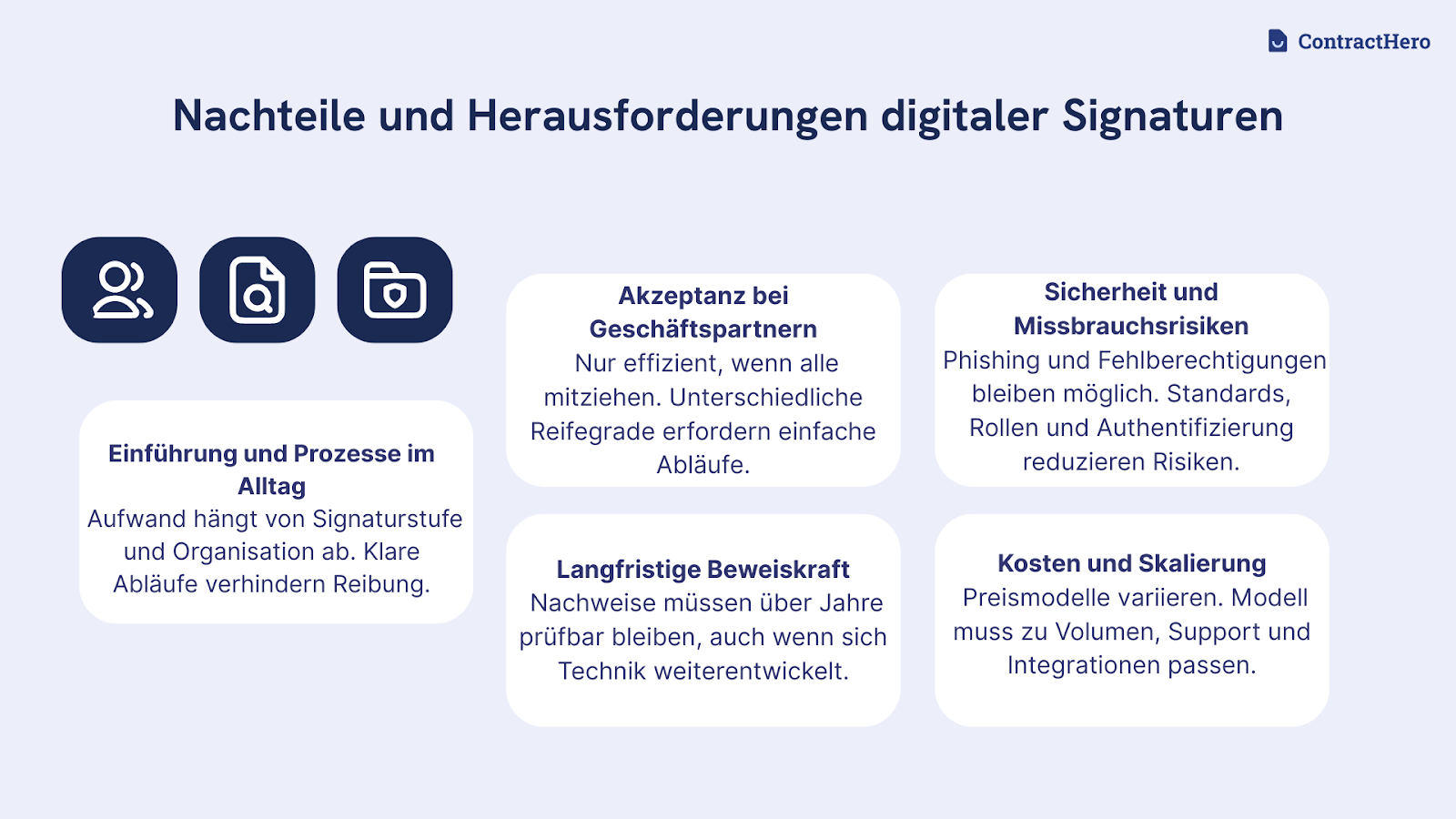
Digital signatures often need to remain reliable for years—for example, for audits, compliance, or future disputes. As technology and security standards continue to evolve, a professional solution must ensure that signatures and evidence are managed in such a way that integrity and verifiability are maintained in the long term.
2) Acceptance by business partners
Digital signatures only work efficiently if all parties involved go along with the process. Some partners are immediately familiar with it, while others need clear instructions or prefer low-threshold signature types at first. This makes it all the more important to have a process that is easy to use and takes into account different levels of maturity on the other side.
3) Security and risks of misuse
Even with secure procedures, risks such as phishing, compromised mailboxes, lost access credentials, or overly broad permissions remain possible. Therefore, the provider should consistently implement security standards and support their operation—for example, through clear roles, logging, and secure authentication. This does not "promise" that misuse will be eliminated, but it does reduce it effectively in practice.
4) Introduction and everyday processes
The effort involved in introducing the system depends heavily on the signature level and organizational complexity. Identification, authentication, and, depending on the team, brief training sessions may be necessary—especially if multiple people, fixed sequences, substitutions, or approvals need to be mapped. A clearly defined process prevents signatures from getting bogged down in minor details in everyday use.
5) Costs and scaling
Cost models vary significantly: per signature, per user, or as a subscription. It is crucial that the model fits the expected contract volume and process—otherwise, it will become unnecessarily expensive as the business grows or inflexible in everyday use. It therefore makes sense to include scaling, support, and integration capabilities in the evaluation in addition to price.
In practice, it is worth choosing a signature solution that integrates seamlessly into existing contract processes. This is exactly what ContractHero is designed for: electronic signature processes can be started directly from the contract, flexibly as FES or QES, depending on requirements. Signatories do not need their own ContractHero account, but sign via an invitation link. Verification is carried out by a provider of your choice. At the same time, ContractHero, as an ISO 27001-certified company, meets high standards for information security.



_BestSupport_QualityOfSupport%20(5).png)